
Hard Money Lenders are a popular financing option for real estate investors and borrowers who need quick access to capital but may not qualify for traditional bank loans. Unlike conventional mortgages that focus heavily on credit scores and income history, hard money loans are usually based on the value of the property being financed.
Many investors use these loans for house flipping, bridge financing, rental property purchases, and time-sensitive deals where speed matters more than long repayment periods. However, higher interest rates and shorter loan terms mean they are not suitable for every borrower.
In this guide, you will learn what hard money lenders do, how their loans work, the advantages and disadvantages, and when using one may make financial sense.
What Are Hard Money Lenders and How Do They Work?
Hard money lenders are private companies or individuals that provide short-term loans secured by real estate. Instead of relying mainly on a borrower’s credit history, these lenders evaluate the property’s value, condition, and potential after repairs.
A hard money loan is usually:
- Secured by real estate as collateral
- Funded faster than traditional mortgages
- Short-term, often lasting 6 months to 3 years
- More expensive because of higher interest rates and fees
For example, a real estate investor purchasing a damaged home for $150,000 may use a hard money lender to fund the purchase and renovation. After improving the property, the investor may refinance into a traditional mortgage or sell the home to repay the loan.

Guide to real estate investment loans
How Do Hard Money Loans Work?
The process of getting a hard money loan is different from applying for a traditional bank mortgage.
Property Evaluation and Loan Approval
Hard money lenders usually start by reviewing:
- Property value
- Location
- Repair costs
- Borrower’s investment plan
- Exit strategy
The lender may order an appraisal or property inspection to determine whether the investment is reasonable.
Loan-to-Value Ratio (LTV) Calculation
Most lenders focus on the loan-to-value ratio, which compares the loan amount with the property value.
For example:
- Property value: $300,000
- Loan amount: $210,000
- LTV ratio: 70%
Many hard money lenders prefer lower LTV ratios because it reduces their risk.
Funding Timeline
One major advantage of hard money loans is speed.
Traditional mortgage approval can take several weeks or months. A hard money loan may sometimes close within a few days because lenders use fewer approval requirements.
This makes them useful for:
- Auction purchases
- Competitive real estate markets
- Emergency financing needs
When Should You Use Hard Money Lenders?
Hard money financing is not designed for every situation. It works best when speed, flexibility, or property value matters more than low borrowing costs.
Real Estate Flipping Projects
House flippers often use hard money loans because they need money quickly to purchase and renovate properties.
Example:
An investor finds a property priced below market value but needs to close within 10 days. A traditional lender may not approve the loan quickly enough, while a hard money lender can provide faster funding.
Bridge Financing
Bridge loans help borrowers cover a temporary financing gap.
Common situations include:
- Buying a new property before selling an existing one
- Waiting for permanent financing approval
- Completing property improvements before refinancing
Borrowers Who Cannot Qualify for Traditional Loans
Some borrowers struggle with bank financing because of:
- Limited credit history
- Self-employment income complexity
- Previous financial issues
Hard money lenders may focus more on the property opportunity than traditional lending requirements.
What Are the Benefits of Hard Money Lenders?
Faster Approval and Funding
Speed is one of the biggest reasons investors choose hard money loans.
Because lenders usually perform fewer income and employment checks, the approval process can move much faster.
Flexible Qualification Requirements
Traditional lenders often have strict requirements. Hard money lenders may consider:
- Property potential
- Investment experience
- Renovation plans
- Exit strategy
Opportunity to Purchase Competitive Deals
In competitive markets, a fast closing can help investors secure properties before other buyers.
A buyer with approved hard money financing may have an advantage over someone waiting for traditional mortgage approval.
What Are the Risks and Drawbacks of Hard Money Loans?
Although hard money loans provide flexibility, borrowers should understand the potential risks.
Higher Interest Rates
Hard money loans generally cost more than traditional mortgages.
Borrowers may pay:
- Higher annual interest rates
- Origination fees
- Processing charges
- Closing costs
The exact cost depends on the lender, property, and borrower profile.
Short Repayment Periods
Most hard money loans are short-term. Borrowers usually need a clear repayment plan.
Common exit strategies include:
- Selling the property
- Refinancing
- Using rental income
Without a strong plan, borrowers may struggle to repay the loan.
Risk of Losing Property
Because the loan is secured by real estate, failure to repay can result in foreclosure.
Borrowers should carefully calculate renovation costs, market conditions, and expected profits before accepting financing.
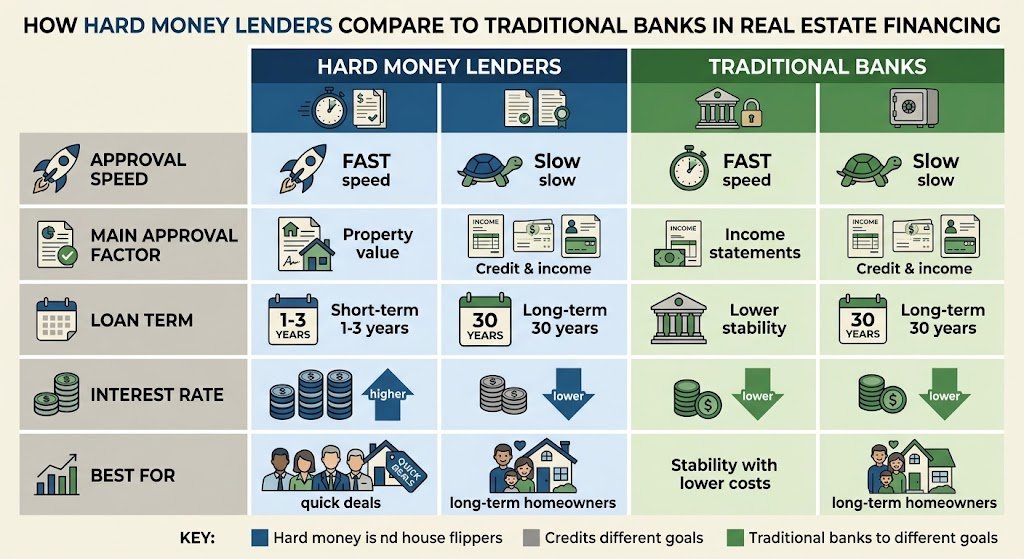
How Are Hard Money Lenders Different From Traditional Banks?
| Feature | Hard Money Lenders | Traditional Banks |
|---|---|---|
| Approval Speed | Faster | Slower |
| Main Approval Factor | Property value | Credit and income |
| Loan Term | Short-term | Long-term |
| Interest Rate | Higher | Lower |
| Best For | Investors and quick deals | Long-term homeowners |
Traditional mortgages are usually better for buyers who want affordable long-term financing. Hard money loans are often chosen when timing and flexibility are more important.
How to Choose the Right Hard Money Lender?
Choosing the right lender can significantly affect your investment results.
Check Experience and Reputation
Look for lenders with:
- Proven real estate lending experience
- Transparent terms
- Positive borrower feedback
- Clear documentation
Compare Loan Terms
Before signing, compare:
- Interest rates
- Loan fees
- Repayment schedule
- Prepayment penalties
- Closing costs
Understand the Exit Strategy
A reliable hard money lender will want to understand how you plan to repay the loan.
A strong exit strategy reduces risk for both parties.
Are Hard Money Loans a Good Choice in 2026?
The usefulness of hard money loans depends on the borrower’s goals, financial situation, and investment strategy.
They can be valuable for experienced investors who understand property markets and need fast funding. However, borrowers should avoid using them without calculating total costs and repayment options.
A practical example:
An investor purchases a $200,000 fixer-upper using a hard money loan, spends $40,000 on renovations, and sells the property for $300,000. The loan works because the investor planned costs, timeline, and repayment before borrowing.
The same loan could create financial problems if repairs exceed the budget or the property takes longer to sell.
Conclusion: Should You Use Hard Money Lenders?
Hard Money Lenders provide fast and flexible financing for real estate investors, property buyers, and borrowers who need alternatives to traditional loans.
They can be useful for short-term opportunities, property renovations, and situations where quick approval matters. However, higher costs and shorter repayment periods require careful planning.
Before choosing a hard money loan, compare lenders, understand the fees, and create a realistic repayment strategy.
FAQ Section
What are hard money lenders?
Hard money lenders are private lenders that provide short-term real estate loans secured by property instead of relying only on traditional credit requirements.
How quickly can hard money lenders approve loans?
Many hard money lenders can approve and fund loans much faster than traditional banks, sometimes within days depending on the property and documentation.
Are hard money loans more expensive than traditional loans?
Yes. Hard money loans usually have higher interest rates and fees because they offer faster approval and more flexible qualification requirements.
Who uses hard money loans?
Real estate investors, house flippers, developers, and borrowers needing short-term financing commonly use hard money loans.
Can I refinance after getting a hard money loan?
Yes. Many borrowers use hard money loans temporarily and refinance into traditional financing after improving the property or meeting lender requirements.