Buying a high-priced home in the United States can require more financing than a standard mortgage allows. Understanding what is a jumbo loan can help home buyers decide whether this type of mortgage fits their budget, income, and long-term financial plans.
A jumbo loan is a mortgage that exceeds the conforming loan limit established for the property’s location and number of units. Because it falls outside the standard loan limits used by Fannie Mae and Freddie Mac, it generally follows different lending and underwriting requirements.
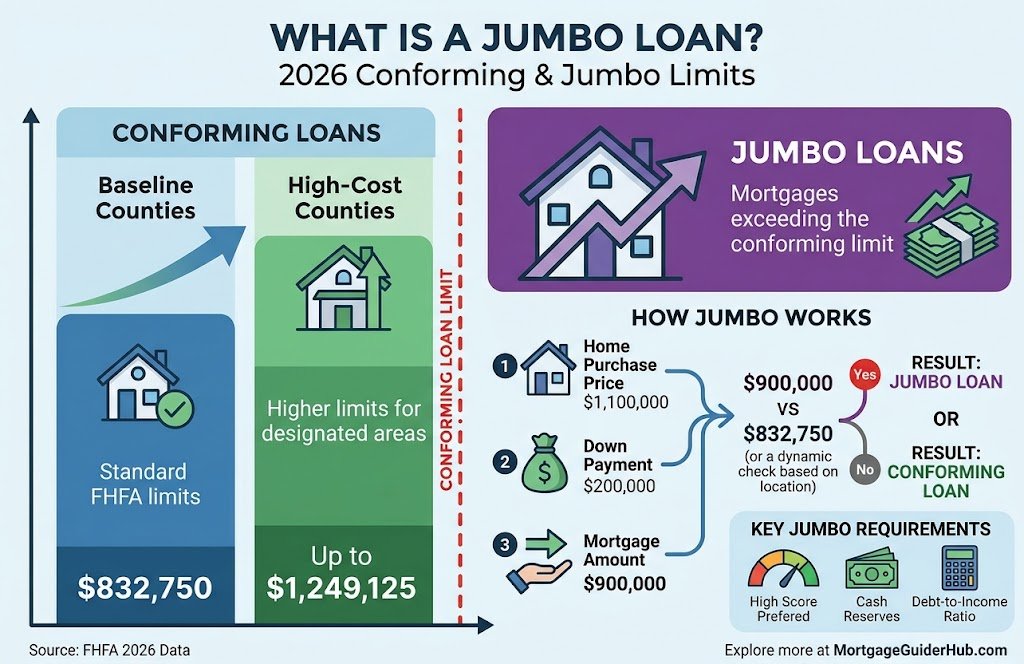
For 2026, the baseline conforming loan limit for a one-unit property in most U.S. counties is $832,750. The limit can be higher in designated high-cost areas, so a mortgage does not automatically qualify as jumbo simply because it exceeds the baseline amount. Source: Federal Housing Finance Agency.
Jumbo financing can help qualified borrowers purchase expensive primary residences, second homes, and certain investment properties. However, lenders may require stronger credit, substantial financial reserves, and detailed income documentation.
This guide from MortgageGuiderHub.com explains jumbo loan limits, qualification requirements, interest rates, down payments, advantages, disadvantages, and practical steps for comparing mortgage offers.
What Is a Jumbo Loan and How Does It Work?
A jumbo loan is a nonconforming mortgage that exceeds the applicable conforming loan limit for a property. Fannie Mae and Freddie Mac generally cannot purchase loans above the relevant limits through their standard conforming mortgage programs.
Instead, jumbo mortgages are commonly funded, retained, or securitized through other lender and investor arrangements. This gives lenders flexibility to establish their own eligibility standards, pricing, and documentation requirements.
How Does a Jumbo Mortgage Work?
The process is similar to obtaining a conventional mortgage, but the lender may examine your finances more closely because the loan amount is larger.
A typical process includes:
- Review your finances: Calculate your income, monthly debts, savings, and expected housing expenses.
- Check the loan limit: Confirm the applicable 2026 conforming limit for the property’s county and number of units.
- Compare lenders: Request quotes from multiple lenders that offer jumbo financing.
- Obtain preapproval: Submit financial documents so the lender can assess your borrowing capacity.
- Complete underwriting: The lender verifies your income, assets, debts, credit history, and the property’s value.
- Close the mortgage: After final approval and satisfaction of closing conditions, you sign the loan documents.
Jumbo loans may have fixed or adjustable interest rates, depending on the lender and program. Some lenders also offer different options for primary homes, vacation properties, and investment properties.
Conventional Loans vs. Jumbo Loans — Complete Comparison
What Are the Jumbo Loan Limits in 2026?
Jumbo loan limits depend on the applicable conforming loan limit, which varies by location and property size. The Federal Housing Finance Agency updates these limits annually.
For a one-unit property in most U.S. counties, the 2026 baseline conforming limit is $832,750. In eligible high-cost areas, the limit can reach $1,249,125. Certain areas, including Hawaii, have special limits.
2026 Conforming Loan Limit Examples
| Property location | One-unit conforming limit |
|---|---|
| Most U.S. counties | $832,750 |
| Eligible high-cost counties in the contiguous U.S. | Up to $1,249,125 |
| Hawaii | Special limits apply; the applicable ceiling can reach $1,299,500 |
These figures are for one-unit properties. Limits for two-, three-, and four-unit properties differ. Always check the official FHFA 2026 conforming loan limits for the exact county and property type.
When Does a Mortgage Become a Jumbo Loan?
Consider a buyer purchasing a home for $1,100,000 in a county with a conforming limit of $832,750.
- Home purchase price: $1,100,000
- Down payment: $200,000
- Mortgage amount: $900,000
- Applicable conforming limit: $832,750
The resulting $900,000 mortgage exceeds the local limit, so it would generally be considered a jumbo loan under the standard conforming-loan definition.
Now imagine the same mortgage amount in an eligible high-cost county with a conforming limit of $1,249,125. The $900,000 loan would not exceed that limit and could potentially qualify as conforming financing, subject to the other program requirements.
The important distinction: Jumbo status depends on the mortgage amount, location, and applicable loan limit—not just the home’s purchase price.
What Are the Jumbo Loan Requirements?
Jumbo loan requirements vary by lender, loan amount, property type, occupancy, and overall borrower risk. There is no single nationwide credit score or down payment requirement that applies to every jumbo mortgage.
However, borrowers should generally be prepared to demonstrate strong credit, reliable income, manageable debt, and sufficient assets.
Credit Score Requirements
Many jumbo lenders prefer credit scores in the high 600s or 700s, and some offer their strongest pricing to borrowers with scores of 740 or higher. These are general market examples, not universal minimums.
A stronger credit profile can help demonstrate responsible borrowing habits. Lenders may also review payment history, outstanding debts, recent credit applications, and the depth of your credit history.
Before applying, consider paying bills on time, reviewing credit reports for errors, and avoiding unnecessary new debt.
Down Payment Requirements
Some jumbo programs allow down payments below 20%, while others require 20% or more, depending on the borrower’s profile and the property.
For example, on a $1,000,000 home:
- 10% down payment: $100,000
- 20% down payment: $200,000
- 25% down payment: $250,000
A larger down payment reduces the mortgage amount and loan-to-value ratio. It may improve eligibility or pricing, but borrowers should avoid using every dollar of savings if doing so would leave insufficient funds for emergencies and closing costs.
Income and Employment Verification
Lenders need evidence that you can afford the monthly payment. Depending on your situation, documentation may include:
- Recent pay stubs and W-2 forms
- Federal tax returns
- Bank and investment account statements
- Business tax returns and profit-and-loss statements for self-employed applicants
- Documentation of bonuses, commissions, rental income, or other eligible earnings
Self-employed borrowers may need to provide additional documentation to establish that their income is stable and sufficient.
Debt-to-Income Ratio
Your debt-to-income ratio (DTI) compares your recurring monthly debt payments with your gross monthly income.
For example, if your gross monthly income is $20,000 and your monthly debt payments total $7,000, your DTI is 35%.
The lender will evaluate the proposed mortgage payment alongside other obligations. Acceptable DTI limits vary by program, and some lenders may compensate for a higher ratio with stronger credit, larger reserves, or a lower loan-to-value ratio.
Cash Reserves and Assets
Jumbo lenders may require borrowers to retain several months of mortgage payments in eligible reserves after closing. The amount depends on the lender, loan size, and borrower circumstances.
Eligible assets may include checking and savings accounts, brokerage accounts, and certain retirement funds, subject to lender rules and any applicable withdrawal restrictions.
Property Appraisal
The lender generally orders an appraisal to assess whether the property provides sufficient collateral for the loan. Higher-value or unusual properties may require additional review or specialized appraisal expertise.
Mortgage Requirements: Credit Score, Income, and Down Payment
What Are Jumbo Mortgage Rates in 2026?
Jumbo mortgage rates are determined by market conditions, lender pricing, and the individual borrower’s financial profile. They may be higher or lower than conforming mortgage rates at a given time.
It is not accurate to assume that jumbo loans always have higher interest rates. Lenders consider their funding costs, investor demand, competition, loan characteristics, and perceived risk.
What Affects Jumbo Loan Interest Rates?
Important factors include:
- Credit score: Stronger credit may qualify for more competitive pricing.
- Down payment: A lower loan-to-value ratio may reduce lender risk.
- Loan amount: Very large loans may have different pricing or eligibility rules.
- Loan type: Fixed-rate and adjustable-rate mortgages have different pricing structures.
- Occupancy: Primary residences, second homes, and investment properties may receive different terms.
- Discount points and fees: Paying points may lower the interest rate but increases upfront costs.
How to Compare Jumbo Mortgage Offers
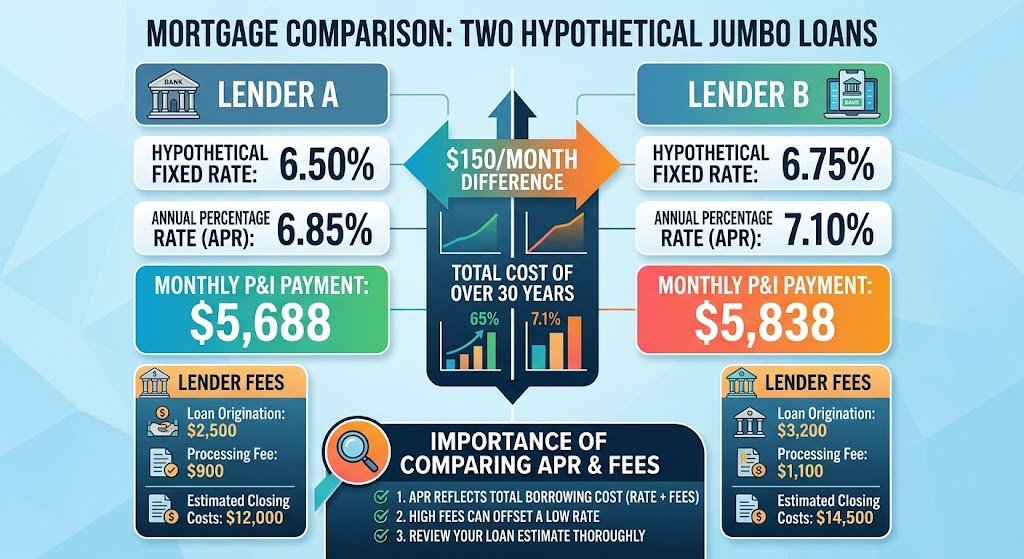
Do not compare offers using the interest rate alone. Review the annual percentage rate (APR), lender fees, discount points, estimated closing costs, monthly payment, and whether the rate is fixed or adjustable.
Ask each lender for a Loan Estimate when applicable, using comparable loan amounts, down payments, terms, and lock periods.
For a simple illustration, a $900,000 mortgage at a hypothetical fixed interest rate of 6.5% over 30 years would have principal-and-interest payments of approximately $5,688 per month. At a hypothetical 6.75% rate, the payment would be approximately $5,838 per month.
That is a difference of about $150 per month, or roughly $1,800 per year. These figures are illustrative only—not current rate quotes—and exclude property taxes, homeowners insurance, HOA fees, and other housing costs.
Jumbo Loan vs. Conventional Loan: What Is the Difference?
A conventional mortgage is a loan that is not insured or guaranteed by a specific government mortgage program. It may be conforming or nonconforming.
A conforming loan meets the applicable requirements and loan limits for the standard Fannie Mae or Freddie Mac programs. A jumbo loan generally exceeds the relevant conforming limit.
| Feature | Conforming conventional loan | Jumbo loan |
|---|---|---|
| Loan amount | Within applicable conforming limit | Above applicable conforming limit |
| Underwriting | Standardized program rules | Lender-specific requirements |
| Credit requirements | Vary by program | Often more demanding |
| Down payment | Varies by program | Varies; may be larger |
| Cash reserves | Depend on the program | May require substantial reserves |
| Interest rate | Depends on borrower and market | Can be higher or lower than conforming rates |
A conforming mortgage may be preferable if your borrowing needs fit within the local limit and you qualify for competitive terms. A jumbo mortgage may be necessary when the amount you need to borrow exceeds that limit.
Some buyers can also compare different down payment amounts to see whether reducing the mortgage would bring it within the conforming limit. This is worth evaluating only if the additional upfront cash remains affordable.
For more guidance, consult the Consumer Financial Protection Bureau’s mortgage information.
What Are the Advantages and Disadvantages of Jumbo Loans?
Jumbo mortgages can make higher-priced properties accessible, but the larger loan amount can increase financial risk.
Advantages of Jumbo Loans
- Higher borrowing capacity: Qualified borrowers can finance homes that exceed conforming loan limits.
- Flexible mortgage choices: Depending on the lender, borrowers may have access to fixed-rate and adjustable-rate options.
- Potentially competitive pricing: Strong applicants may receive attractive offers when lenders compete for their business.
- One primary mortgage: A jumbo loan may avoid the need to combine a conforming first mortgage with a separate financing arrangement.
Disadvantages of Jumbo Loans
- Stricter qualification: Lenders may require stronger credit, more income documentation, and greater reserves.
- Larger monthly payments: Borrowing more generally means paying more each month.
- Potentially higher upfront costs: A large down payment and closing expenses can require substantial cash.
- Greater financial exposure: Changes in income, unexpected expenses, or falling property values can be more difficult to manage with a large mortgage.
A jumbo loan should fit your overall finances, not just your ability to obtain lender approval. Consider how the payment would affect retirement contributions, emergency savings, childcare, and other long-term goals.
How Can You Qualify for a Jumbo Mortgage?
Preparation can make the application process more efficient and help you compare realistic options.
Set a Sustainable Budget
Calculate the total expected housing cost, including principal, interest, property taxes, homeowners insurance, HOA dues, maintenance, and any applicable mortgage insurance.
Do not rely only on the maximum amount a lender says you can borrow.
Review Your Credit and Debt
Check your credit reports, resolve errors, and assess whether paying down existing debt could improve your financial position. Avoid making major financial changes before closing without consulting your lender.
Organize Financial Documents
Prepare income records, bank statements, tax documents, and proof of assets. If you are self-employed, ask the lender early about business income and documentation requirements.
Compare Multiple Lenders
Request comparable quotes from banks, credit unions, mortgage brokers, and other lenders that offer jumbo mortgages. Ask about minimum down payments, reserve requirements, rate-lock periods, fees, and prepayment provisions.
Obtain Preapproval
A preapproval can help you understand a likely borrowing range before making an offer. It is not a final approval or a guarantee that the loan will close.
Review the Final Loan Terms
Before signing, confirm the interest rate, APR, loan term, monthly payment, closing costs, and any adjustable-rate features. Ask questions about terms you do not understand.
How to Get Pre-Approved for a Mortgage: Step-by-Step Guide
Is a Jumbo Loan Right for You?
A jumbo mortgage may be suitable if you need to borrow above the local conforming loan limit and have the income, credit, and assets required by the lender.
It may be less suitable if the monthly payment would leave little room for emergencies or if the down payment would deplete your savings. In some cases, a larger down payment or a less expensive property could provide a more comfortable financial outcome.
Before deciding, compare at least a few mortgage offers and review your budget under different interest-rate and expense scenarios. The best loan is not necessarily the one with the largest approval amount; it is the one that supports your housing needs without putting other financial priorities at risk.
Conclusion
Understanding what is a jumbo loan helps home buyers make informed decisions when financing a high-value property. In 2026, the baseline conforming loan limit for a one-unit home in most U.S. counties is $832,750, although eligible high-cost areas have higher limits.
Jumbo loan requirements, rates, down payments, and reserve rules vary by lender. Review the applicable local loan limit, prepare your financial documents, and compare loan estimates before making a commitment.
Visit MortgageGuiderHub.com for more educational resources about home loans, mortgage requirements, interest rates, and the home-buying process. Use the information to prepare questions for a qualified mortgage professional and choose financing that suits your circumstances.