Buying a home is one of the biggest financial decisions most people make, and understanding your loan options is the first step toward making a confident choice. Conventional Mortgages Explained: Requirements, Rates & Benefits (2026) helps buyers understand how these popular home loans work, who qualifies, and why they remain a top choice for many Americans.
A conventional mortgage is a home loan that is not insured or guaranteed by the federal government. Instead, it follows guidelines established by mortgage investors such as Fannie Mae and Freddie Mac. These loans are widely used because they offer competitive interest rates, flexible terms, and options for borrowers with strong financial profiles.
In simple terms, a conventional mortgage allows qualified buyers to purchase or refinance a home with requirements based on credit score, income, debt levels, and down payment. The better your financial profile, the more favorable your loan terms may be.
This guide explains conventional mortgage requirements, expected rates, benefits, drawbacks, and how these loans compare with other mortgage options in 2026.

What Are Conventional Mortgages? A Simple 2026 Explanation
A conventional mortgage is a type of home loan offered by private lenders, including banks, credit unions, and mortgage companies. Unlike FHA, VA, or USDA loans, conventional loans are not backed by a government agency.
Instead, lenders follow specific standards that determine whether a borrower qualifies. These standards help reduce risk while allowing lenders to offer competitive mortgage products.
According to the Consumer Financial Protection Bureau (CFPB), conventional loans are among the most common mortgage choices available to American home buyers because they provide multiple repayment options and work well for borrowers with stable finances.
Mortgage Basics Guide
How Conventional Mortgage Loans Work
Conventional mortgage loans work through a simple process:
- A borrower applies with a mortgage lender.
- The lender reviews credit history, income, assets, and debt.
- The borrower receives loan approval based on eligibility.
- The lender provides funds to purchase or refinance a property.
- The borrower repays the loan through monthly payments.
Monthly payments usually include:
- Principal amount
- Interest charges
- Property taxes
- Homeowners insurance
- Private mortgage insurance (if required)
The loan term can vary, but the most common option is a 30-year fixed-rate mortgage. Some buyers also choose 15-year terms to reduce total interest costs and build home equity faster.
Conventional vs Government-Backed Loans
Many buyers compare conventional mortgages with government-backed loans. The main difference is who supports the loan.
| Loan Type | Government Backing | Typical Borrower |
|---|---|---|
| Conventional Mortgage | No | Buyers with good credit and stable income |
| FHA Loan | Federal Housing Administration | Buyers needing flexible qualification |
| VA Loan | Department of Veterans Affairs | Eligible veterans and service members |
| USDA Loan | U.S. Department of Agriculture | Buyers in eligible rural areas |
Conventional loans often provide more flexibility for borrowers who have higher credit scores and enough savings for a down payment.
Conventional Mortgage Requirements in 2026
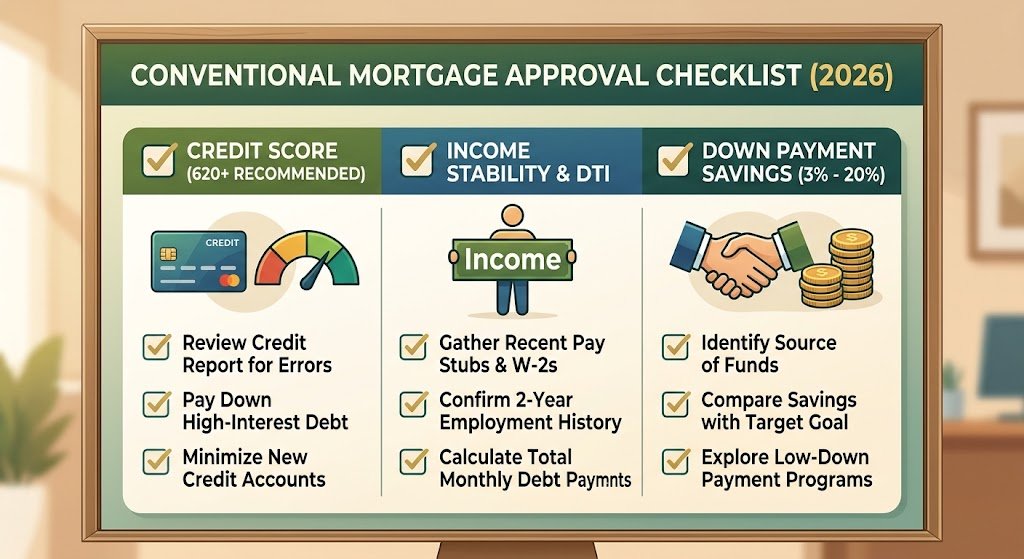
Understanding eligibility requirements is one of the most important parts of choosing a mortgage. While requirements vary by lender, most conventional mortgage loans follow similar qualification standards.
A lender typically evaluates five major areas:
- Credit score
- Income stability
- Debt-to-income ratio
- Down payment
- Employment history
Meeting these requirements can improve your chances of approval and may help you receive better interest rates.
Minimum Credit Score Requirements
Credit score is one of the biggest factors affecting conventional mortgage approval.
Most lenders prefer borrowers with a credit score of 620 or higher, although some lenders may require stronger credit depending on the loan amount and financial situation.
A higher credit score may help borrowers:
- Qualify for lower interest rates
- Reduce monthly payments
- Avoid higher fees
- Receive better loan terms
For example, a borrower with a 760 credit score may receive a more competitive rate compared with someone applying with a score near the minimum requirement.
Improving your credit before applying can make a significant difference in long-term mortgage costs.
Down Payment Rules and Options
One common misconception is that conventional mortgages always require a large down payment. While many buyers choose to put down 20%, some conventional programs allow much smaller down payments.
Typical options include:
- 20% down payment — helps avoid private mortgage insurance
- 5% down payment — common choice for many buyers
- 3% down payment — available through certain conventional programs
A larger down payment can provide several advantages:
- Lower monthly payments
- Reduced interest costs
- Less borrowing risk
- More home equity from the beginning
However, saving for a large down payment should not prevent qualified buyers from exploring available options.
Debt-to-Income Ratio (DTI) Guidelines
Lenders use debt-to-income ratio to measure whether a borrower can comfortably manage monthly payments.
DTI compares your total monthly debt payments with your gross monthly income.
Example:
If your monthly income is $6,000 and your total debts are $2,100:
$2,100 ÷ $6,000 = 35% DTI
Many lenders prefer a DTI ratio below 36%, although some borrowers may qualify with higher ratios depending on credit score, savings, and overall financial strength.
Lower debt levels usually improve mortgage approval chances.
Conventional Mortgage Requirements in 2026 (Continued)
Income, Employment, and Asset Verification
Lenders want to confirm that borrowers have a reliable source of income to make consistent mortgage payments. During the approval process, lenders usually review employment history, income documents, and available assets.
Common documents include:
- Recent pay stubs
- W-2 forms
- Tax returns for self-employed borrowers
- Bank statements
- Investment account statements
A stable employment history can strengthen your mortgage application. However, changing jobs does not automatically disqualify you. Lenders may consider your overall career history, income consistency, and ability to repay the loan.
For self-employed applicants, lenders typically analyze business income, tax records, and financial stability over multiple years.
A practical example: A borrower earning $90,000 annually with low existing debt may qualify for better terms than someone earning $120,000 but carrying significant monthly obligations. Mortgage approval is not based on income alone; lenders evaluate the complete financial picture.
Conventional Mortgage Rates in 2026: What Buyers Should Know
Mortgage rates are one of the most important factors affecting affordability. Even a small rate difference can change monthly payments and the total amount paid over the life of a loan.
Conventional mortgage rates in 2026 depend on several market and borrower-specific factors, including:
- Federal Reserve interest rate decisions
- Inflation trends
- Credit score
- Loan amount
- Down payment size
- Property type
- Debt-to-income ratio
Borrowers with stronger financial profiles generally receive more competitive offers because lenders view them as lower-risk applicants.
Factors That Affect Conventional Loan Rates
Interest rates are not the same for every borrower. Two buyers purchasing similar homes may receive different rates because their financial situations differ.
Important factors include:
Credit Score
A higher credit score often leads to lower interest rates because it demonstrates responsible borrowing behavior.
Loan-to-Value Ratio (LTV)
The amount borrowed compared with the home’s value affects lender risk. A lower LTV usually results in better pricing.
Loan Term
A 15-year mortgage typically has a lower interest rate than a 30-year mortgage, but monthly payments are higher because the loan is paid faster.
Market Conditions
Economic conditions, inflation, and bond market performance influence mortgage rates nationwide.
Fixed-Rate vs Adjustable-Rate Conventional Mortgages
Borrowers choosing conventional mortgages generally select between fixed-rate and adjustable-rate options.
Fixed-Rate Mortgage
A fixed-rate mortgage keeps the same interest rate throughout the loan term.
Benefits include:
- Predictable monthly payments
- Easier budgeting
- Protection from future rate increases
This option is popular among buyers planning to stay in their homes long term.
Adjustable-Rate Mortgage (ARM)
An adjustable-rate mortgage starts with a fixed introductory period before the rate changes according to market conditions.
Advantages may include:
- Lower initial payments
- Lower starting interest rates
However, payments can increase after the adjustment period.
Choosing between these options depends on your financial goals, expected homeownership period, and risk tolerance.
Benefits of Conventional Mortgage Loans for Home Buyers
Conventional mortgage loans remain popular because they provide advantages that fit many different types of borrowers.
Lower Costs for Qualified Borrowers
Borrowers with strong credit profiles often receive competitive interest rates and lower fees compared with some government-backed alternatives.
Over a 15- or 30-year loan period, even a small reduction in interest rate can save thousands of dollars.
For example, reducing a mortgage rate by only 0.5% on a $350,000 loan can create meaningful savings over time, depending on the loan term and repayment schedule.
More Property and Loan Flexibility
Conventional mortgages often provide more flexibility regarding property types.
They may be used for:
- Primary residences
- Second homes
- Investment properties
They also generally have fewer property restrictions compared with some specialized loan programs.
This flexibility makes conventional loans attractive for buyers who want more options.
No Upfront Mortgage Insurance Requirement
Unlike FHA loans, conventional mortgages do not require an upfront mortgage insurance premium.
However, borrowers who put down less than 20% may need to pay private mortgage insurance (PMI).
The advantage is that PMI can usually be removed once sufficient home equity is reached, depending on lender requirements and loan conditions.
Conventional Mortgages Explained: Pros and Cons in 2026
Before choosing a mortgage, buyers should understand both the advantages and limitations.
Advantages of Conventional Loans
Key benefits include:
Potential Drawbacks to Consider
Although conventional mortgages work well for many buyers, they may not be ideal for everyone.
Possible challenges include:
- Higher credit requirements compared with some government loans
- Larger down payment expectations
- Stricter income verification
- Higher qualification standards
Borrowers with limited credit history or smaller savings may find other mortgage options more suitable.
How to Apply for a Conventional Mortgage Loan Step by Step
Applying for a mortgage does not have to be complicated when you understand the process.
Review Your Financial Profile
Before applying, check:
- Credit score
- Monthly debts
- Savings
- Income stability
Improving your financial position before applying may help you qualify for better terms.
[INTERNAL LINK: Credit Score Improvement Guide]
Compare Multiple Lenders
Mortgage rates and fees vary between lenders. Comparing multiple offers can help borrowers find better terms.
Consider comparing:
- Interest rates
- Closing costs
- Loan terms
- Customer service
- Preapproval timelines
A lower advertised rate is not always the cheapest option because fees can affect the overall cost.
Get Preapproved
Mortgage preapproval helps buyers understand their realistic budget before searching for a home.
During preapproval, lenders review financial documents and estimate how much you may qualify to borrow.
Benefits include:
- Stronger purchase offers
- Clear home-buying budget
- Faster loan processing later
Complete the Final Approval Process
After selecting a property, the lender completes underwriting.
This includes:
- Property appraisal
- Document verification
- Final financial review
Once approved, the borrower moves toward closing and receives the keys to the property.
Conventional Mortgage Loans vs FHA Loans: Which Is Better?
Many first-time buyers compare conventional mortgages with FHA loans because both are widely available.
Key Differences Between FHA and Conventional Loans
| Feature | Conventional Mortgage | FHA Loan |
|---|---|---|
| Credit Requirements | Usually higher | More flexible |
| Down Payment | As low as 3% for some programs | Often 3.5% minimum |
| Mortgage Insurance | PMI may be removed | Often required longer |
| Property Rules | More flexible | More restrictions |
Who Should Choose a Conventional Mortgage?
A conventional mortgage may be a better choice if you:
- Have a strong credit score
- Want lower long-term costs
- Plan to build home equity
- Want flexibility with property choices
An FHA loan may be worth considering if you have limited savings or a lower credit score.
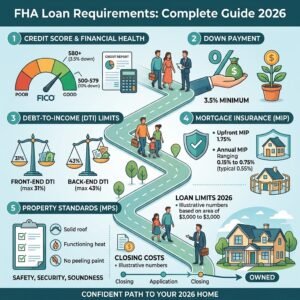
FHA Loan Requirements Explained
Common Mistakes to Avoid When Choosing a Conventional Mortgage
Choosing the right mortgage is not only about getting approved. Many borrowers focus only on the interest rate and overlook other factors that can affect their long-term financial situation.
Avoiding common mistakes can help you save money and choose a loan that matches your goals.
Ignoring Total Loan Costs
A mortgage involves more than the monthly payment. Buyers should consider the complete cost of borrowing, including:
- Interest charges
- Closing costs
- Origination fees
- Private mortgage insurance (PMI)
- Property taxes
- Homeowners insurance
A loan with a slightly lower interest rate may not always be the cheapest option if it comes with higher fees.
Always review the loan estimate provided by your lender before making a final decision.
Applying Without Improving Credit
Many buyers apply immediately without checking their credit profile first.
Before submitting a mortgage application, consider:
- Paying down high-interest debt
- Correcting credit report errors
- Avoiding new credit accounts
- Making payments on time
Even a small credit improvement may help you qualify for better mortgage terms.
Not Comparing Multiple Mortgage Offers
One of the biggest mistakes home buyers make is accepting the first mortgage offer they receive.
Different lenders may provide different:
- Interest rates
- Closing costs
- Loan programs
- Customer service experiences
Comparing at least three mortgage offers can help borrowers identify better opportunities and avoid unnecessary costs.
Is a Conventional Mortgage Right for You in 2026?
A conventional mortgage remains one of the most popular financing options for American home buyers because it balances flexibility, competitive pricing, and long-term benefits.
Conventional Mortgages Explained: Requirements, Rates & Benefits (2026) shows that these loans are especially useful for borrowers with stable income, good credit, and enough savings for a down payment.
However, the best mortgage depends on your personal financial situation. A buyer with excellent credit may benefit from a conventional loan, while someone with limited savings or a lower credit score may find another program more suitable.
Before choosing a mortgage, evaluate your:
- Credit score
- Monthly budget
- Long-term housing plans
- Savings amount
- Future financial goals
Taking time to compare options can help you avoid costly decisions and choose a mortgage that supports your financial future.
Frequently Asked Questions About Conventional Mortgages
What is a conventional mortgage loan?
A conventional mortgage loan is a home loan provided by a private lender that is not insured or guaranteed by the federal government. It follows guidelines commonly used by mortgage investors such as Fannie Mae and Freddie Mac.
What credit score is needed for a conventional mortgage in 2026?
Most lenders typically look for a credit score of around 620 or higher for conventional mortgage approval. However, borrowers with higher scores may receive better interest rates and loan terms.
How much down payment is required for a conventional mortgage?
Some conventional mortgage programs allow down payments as low as 3%, while many borrowers choose to put down 5% to 20%. A larger down payment can reduce monthly costs and may eliminate PMI.
Are conventional mortgage rates lower than FHA rates?
Conventional mortgage rates can be lower for borrowers with strong credit profiles. FHA loans may offer easier qualification requirements but include mortgage insurance costs that can affect the total expense.
Is a conventional mortgage better for first-time home buyers?
Yes, many first-time buyers choose conventional mortgages because they offer flexible down payment options, competitive rates, and the ability to remove PMI after building enough equity.
How long does conventional mortgage approval take?
The timeline varies by lender and borrower situation, but many conventional mortgage applications take several weeks from application to closing. Preparing documents early can speed up the process.