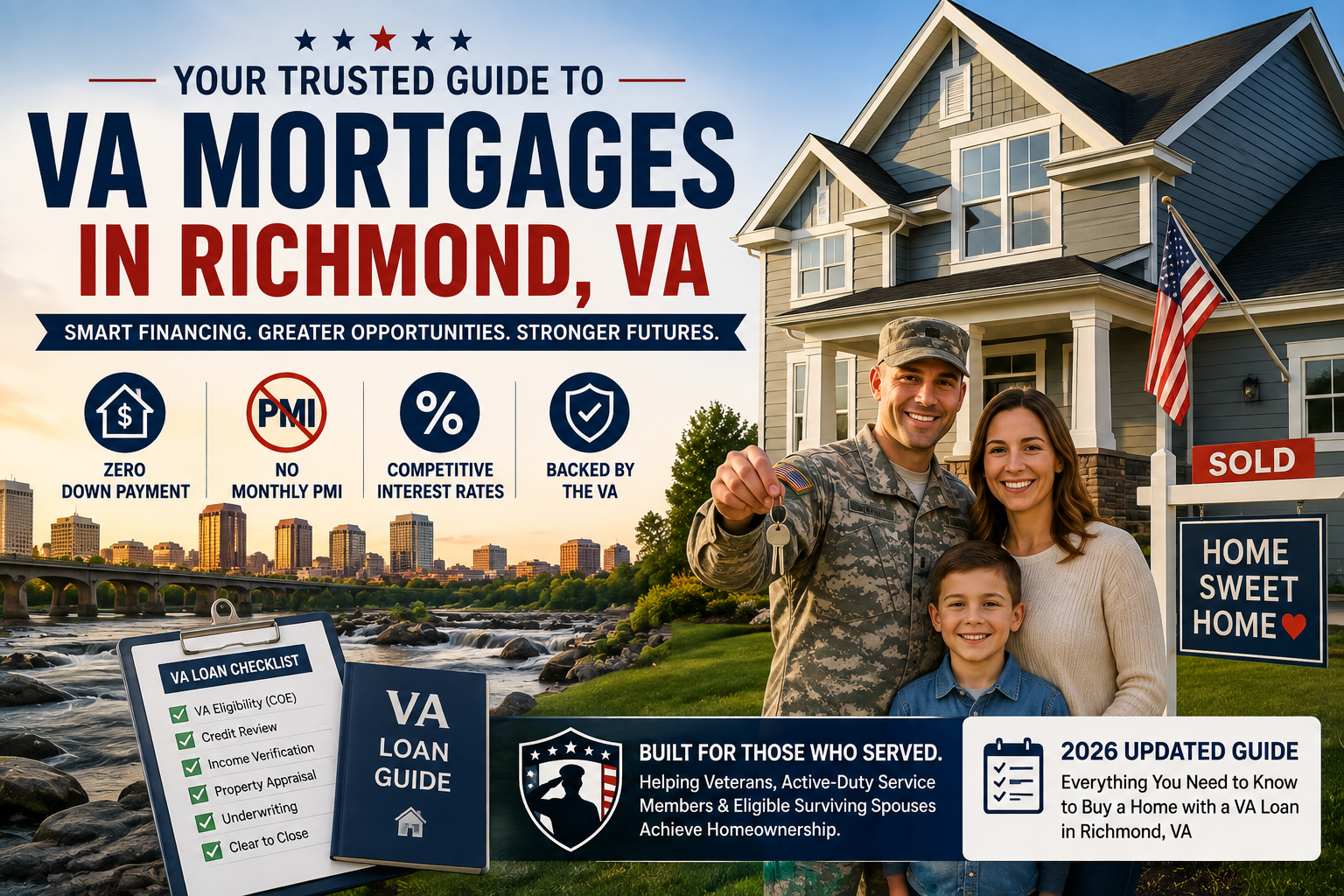
How Veterans in Richmond Can Buy a Home With No Down Payment
Buying a home is a major goal for many Veterans, but saving money for a down payment can seem impossible. For Veterans in Richmond, Virginia, a VA-backed home loan can provide an option for purchasing a home with no down payment.
One of the biggest advantages of VA home loans is that eligible borrowers may be able to buy a home with no down payment. This means you may not have to save thousands of dollars before purchasing a home. For example, if you want to buy a $350,000 home, a conventional mortgage with a 10% down payment could require $35,000, while a 20% down payment could require $70,000. With a qualifying VA loan, you may be able to purchase the home without a down payment.
VA loans also do not require monthly mortgage insurance. This can help reduce the monthly cost of homeownership. However, buyers may still need to pay closing costs, inspections, appraisal fees, and potentially a VA funding fee unless they qualify for an exemption.
This guide explains how Veterans in Richmond can buy a home with no down payment, including eligibility, the Certificate of Eligibility, pre-approval, appraisal, closing costs, and the steps involved in the home-buying process.
What Is a VA Home Loan?
A VA home loan is a benefit available to eligible Veterans, service members, and some surviving spouses. It can help eligible borrowers buy, build, or improve a home.
With a VA-backed mortgage, a private lender provides the loan while the Department of Veterans Affairs guarantees part of the loan. This guarantee can allow participating lenders to offer favorable financing options to eligible borrowers.
One of the major benefits of VA financing is the possibility of buying a home with no down payment. According to the source material, this generally applies when the sales price does not exceed the home\’s appraised value and the borrower meets the applicable requirements.
VA loans also do not require monthly mortgage insurance, which can make homeownership more affordable for eligible Veterans in Richmond.

Can Veterans in Richmond Really Buy a Home With No Down Payment?
Yes. Eligible Veterans may be able to purchase a home in Richmond with no down payment. However, borrowers still need to meet VA and lender requirements.
You generally need to:
- Obtain a VA Certificate of Eligibility (COE)
- Meet the VA\’s eligibility requirements
- Meet your lender\’s credit and income requirements
- Have sufficient income to support the mortgage
- Meet debt and underwriting requirements
- Plan to occupy the property as your home
- Purchase a property that meets applicable requirements
- Complete the VA appraisal process
The VA does not establish one universal minimum credit score for every VA loan. However, individual lenders may have their own credit requirements. Therefore, being eligible for a VA benefit does not automatically guarantee mortgage approval.
Why No Down Payment Helps Richmond Veterans
A down payment is normally one of the largest upfront expenses when buying a home.
For example, imagine you want to purchase a $400,000 home. Depending on the mortgage program, a conventional loan could require a down payment of $20,000, $40,000, or even $80,000.
For many families, saving that amount can take years.
With an eligible VA loan, you may not need to make a down payment. This allows you to potentially keep more of your savings available for:
- Emergency expenses
- Moving costs
- Home repairs
- Furniture and household expenses
- Other unexpected costs
Who May Qualify for a VA Home Loan?
VA home loan eligibility is generally based on military service, duty status, and other factors.
Eligible borrowers can include:
- Veterans
- Active-duty service members
- National Guard members
- Reserve members
- Some surviving spouses
The specific service requirements can depend on when and how you served. If you are unsure about your eligibility, you should check with the VA and obtain your Certificate of Eligibility.
What Is a Certificate of Eligibility?
A Certificate of Eligibility, commonly called a COE, is a document showing that you qualify for VA home loan benefits.
You can request a COE online, through a participating lender, or by mail. Depending on your situation, you may need documents such as discharge paperwork or a statement of service.
Getting your Certificate of Eligibility early can help you understand your VA eligibility before you begin seriously shopping for a home.
How to Get Your VA Certificate of Eligibility
You generally have three options for obtaining your COE:
- Request it online through the VA website.
- Ask your lender to request it for you.
- Request it by mail using the appropriate VA form.
Once you receive your Certificate of Eligibility, you can provide it to your lender as part of the mortgage process.
Step-by-Step Guide to Buying a Richmond Home With a VA Loan
Step 1: Review Your Finances
Before looking for a home in Richmond, review your income, expenses, savings, and debts.
Consider costs such as:
- Mortgage payment
- Property taxes
- Homeowners insurance
- HOA fees
- Utilities
- Transportation
- Existing debts
- Emergency savings
Do not choose a home simply because it is the maximum amount a lender says you can borrow. Instead, consider what monthly payment you can comfortably afford.
Step 2: Check Your Credit
Your credit history can affect your mortgage application.
Although the VA does not set one minimum credit score for all VA loans, individual lenders may have their own requirements.
Before applying, review your credit reports and look for errors. If you find inaccurate information, consider taking steps to correct it before applying for a mortgage.
Step 3: Get Pre-Approved by a VA Lender
Pre-approval is an important step before you start making offers.
During pre-approval, the lender may review your income, employment, credit, debts, and other financial information to determine how much you may be able to borrow.
Pre-approval helps you understand your budget and can make the home-buying process more organized.
It is also useful to compare VA lenders. Ask about:
- Interest rates
- Lender fees
- Closing costs
- Estimated cash to close
- Overall loan terms
Step 4: Understand Your VA Entitlement
Your VA entitlement is an important part of your home loan benefit.
Your Certificate of Eligibility provides information about your entitlement. If you have previously used a VA loan, your available entitlement may be different.
If you have used your VA benefit before, ask your lender to review your current entitlement before making an offer.
Step 5: Set a Home-Buying Budget
After pre-approval, establish a realistic price range.
Remember that homeownership involves more than the mortgage payment. You should also consider:
- Property taxes
- Homeowners insurance
- Repairs
- Maintenance
- HOA fees
- Utilities
Do not automatically purchase the most expensive home you qualify for. Choose a property that fits comfortably within your overall budget.
Step 6: Find a Richmond Home
Richmond offers different types of properties, including single-family homes, townhomes, and condominiums.
When choosing a home, consider factors such as:
- Location
- Commute
- Schools
- Neighborhood amenities
- Property condition
- Future plans
- Long-term affordability
The VA loan benefit gives eligible borrowers flexibility in financing, but the property should still fit your financial needs and lifestyle.
Step 7: Work With a Real Estate Agent Who Understands VA Loans
A real estate agent familiar with VA transactions can be helpful throughout the home-buying process.
Your agent can help you:
- Find suitable homes
- Prepare offers
- Negotiate sale terms
- Coordinate inspections
- Communicate with your lender
- Address appraisal issues
- Prepare for closing
When choosing an agent, ask how frequently they work with buyers using VA loans.
An experienced agent may be better prepared to explain VA-related considerations involving appraisals, seller credits, property requirements, and transaction timelines.
Step 8: Make an Offer on a Home
Once you find a Richmond home you like, your real estate agent can help you prepare an offer.
Important factors may include:
- Purchase price
- Earnest money
- Financing terms
- Home inspection
- Appraisal
- Closing date
- Seller credits
- Contract contingencies
You do not have to overpay simply to make your offer competitive.
Stay within the budget you established with your lender and consider the property\’s value and condition.
Step 9: Get a VA Appraisal
After your offer is accepted, the lender will order a VA appraisal.
The appraisal estimates the home\’s market value and helps determine whether the property meets applicable VA requirements.
It is important to understand that an appraisal is not the same thing as a home inspection. An appraisal focuses on value and VA requirements and does not guarantee that a home is free from defects.
For zero-down financing, the purchase price generally cannot exceed the appraised value without addressing the difference through an appropriate solution.
What Happens If the Appraisal Is Lower Than Your Offer?
Suppose you offer $400,000 for a Richmond home, but the VA appraisal determines that the property is worth $385,000.
That creates a $15,000 difference.
Depending on the situation, possible options may include:
- Negotiating with the seller
- Requesting reconsideration of the value
- Renegotiating the purchase price
- Walking away if permitted under the contract
- Bringing additional money to the transaction if appropriate
Your lender and real estate agent can explain the options available in your specific transaction.
Step 10: Get a Home Inspection
Even though the VA appraisal is required, getting a professional home inspection can still be an important part of the buying process.
A home inspector may examine areas such as:
- Roof
- Foundation
- Electrical systems
- Plumbing
- HVAC system
- Windows
- Attic
- Basement
- Appliances
- Other major components
An inspection can identify problems that may not be obvious during a normal home viewing.
Spending money on an inspection can potentially help you avoid expensive surprises after moving into the property.
Step 11: Understand the VA Funding Fee
Even with a zero-down VA loan, you may still have to pay a VA funding fee.
The funding fee is a one-time charge that helps support the VA home loan program.
Not every borrower has to pay it. Some Veterans and other eligible borrowers may qualify for an exemption.
The funding fee can depend on factors such as:
- Whether you have used a VA loan before
- The amount of your down payment
- The type of VA loan
- Your individual eligibility circumstances
The source material states that the funding fee can range from 0.5% to 3.3%.
Ask your lender to calculate your applicable funding fee before closing.
Can You Avoid the VA Funding Fee?
Some eligible Veterans do not have to pay the VA funding fee.
You should not assume that you are required to pay it or automatically assume that you are exempt.
Your lender can review your Certificate of Eligibility and other relevant information to determine whether the funding fee applies to you.
Step 12: Understand Closing Costs
A zero-down VA loan does not mean that buying a home requires zero cash.
You may still have costs such as:
- Appraisal fees
- Title services
- Title insurance
- Recording fees
- Loan-related charges
- Homeowners insurance
- Property taxes
- Other settlement expenses
The exact amount of closing costs varies from one transaction to another.
Ask your lender for an estimate of the amount of cash you will need to close so you can prepare before signing the final documents.
Can the Seller Help With Closing Costs?
In some transactions, the seller may agree to help with certain buyer closing costs.
However, seller credits and concessions are subject to applicable VA rules and transaction requirements.
If a seller is willing to provide credits, those credits may reduce the amount of cash you need at closing.
Your lender should review proposed seller credits before you finalize the transaction, while your real estate agent can help negotiate the terms.
Step 13: Enjoy the No-PMI Advantage
One of the major benefits of VA financing is that eligible borrowers do not have to pay private mortgage insurance every month.
Conventional mortgages may require PMI when a borrower makes a smaller down payment.
VA-backed purchase loans do not require monthly PMI.
This can help make the monthly housing payment more affordable compared with certain other financing options.
However, your total housing payment can still include:
- Principal
- Interest
- Property taxes
- Homeowners insurance
- HOA fees
Always calculate your complete monthly housing cost before deciding how much home you want to purchase.
Step 14: Complete Underwriting
After the purchase contract is signed, your lender will continue the underwriting process.
You may need to provide documents such as:
- Pay stubs
- Bank statements
- W-2 forms
- Tax information
- Employment information
- Identification
- Other financial documents
Respond quickly when your lender requests information.
You should also avoid making major financial changes before closing. For example, avoid opening multiple new credit accounts or taking on significant new debt without first speaking with your lender.
Step 15: Review Your Closing Disclosure
Before closing, carefully review your Closing Disclosure.
Check:
- Loan amount
- Interest rate
- Monthly payment
- Closing costs
- Taxes
- Insurance
- Seller credits
- Cash needed to close
If anything is unclear or different from what you expected, ask your lender to explain it before signing.
Taking time to review the documents can help you understand the transaction and avoid unexpected issues.
Step 16: Move Into Your Richmond Home
Once underwriting is complete and all required conditions have been satisfied, you can move forward with closing.
At closing, you will sign the mortgage and property documents and complete the purchase transaction.
After the purchase is finalized, you can move into your Richmond home.
For Veterans, this can represent more than a real estate transaction. It can be an important step toward homeownership and long-term financial stability.
Can You Buy a Duplex With a VA Loan?
Yes, it may be possible.
VA-backed purchase loans can be used for properties with up to four units, subject to applicable requirements.
For example, an eligible Veteran could potentially purchase a duplex, live in one unit, and rent the other.
However, owner-occupancy, underwriting, and rental-income rules can apply.
If you are considering a duplex, speak with your VA lender before making an offer so you understand the requirements.
Can Veterans Buy a Condo With a VA Loan?
Yes, eligible borrowers may be able to use VA financing to purchase a condominium.
However, the condominium project must meet applicable VA requirements, and not every condo automatically qualifies.
Before making an offer on a Richmond condo, ask your lender to confirm that the project meets VA requirements.
Checking this before signing a contract can help prevent unnecessary delays.
Can You Use a VA Loan More Than Once?
Yes, it may be possible to use your VA home loan benefit more than once.
Your ability to reuse the benefit depends on factors such as your available entitlement and previous VA loan history.
If you have previously used a VA loan, do not automatically assume that your benefit is permanently unavailable.
Ask your lender to review your Certificate of Eligibility and current entitlement.
Common Mistakes Richmond Veterans Should Avoid
Mistake 1: Thinking Zero Down Means Zero Cash
You may still need money for closing costs, inspections, and other expenses.
Mistake 2: Buying Before Pre-Approval
Pre-approval helps establish a realistic price range before you start making offers.
Mistake 3: Choosing the First Lender
Compare lenders based on rates, fees, loan terms, and service.
Mistake 4: Ignoring the Appraisal
The appraised value can have an important effect on the transaction.
Mistake 5: Skipping the Inspection
A VA appraisal does not replace a professional home inspection.
Mistake 6: Spending All Your Savings
Unexpected home repairs can be expensive, so maintaining emergency savings can be important.
Mistake 7: Taking on New Debt
New debt can create complications during underwriting.
Mistake 8: Assuming Every Property Qualifies
Different property types can have specific requirements.
Mistake 9: Forgetting Taxes and Insurance
Property taxes and homeowners insurance can significantly affect your total monthly payment.
Mistake 10: Failing to Compare Loan Offers
Different lenders may offer different rates, fees, and terms.
Tips for Buying a Richmond Home With Zero Down
If you want to make the most of your VA home loan benefit, preparation can make the process easier.
- Verify your VA eligibility early.
- Get your Certificate of Eligibility before seriously shopping.
- Build a realistic home-buying budget.
- Consider the full cost of homeownership.
- Compare multiple lenders.
- Review interest rates and fees.
- Estimate your cash-to-close amount.
- Get pre-approved before making offers.
- Work with a real estate agent experienced with VA loans.
- Get a professional home inspection.
- Review the VA appraisal.
- Plan for closing costs.
- Keep emergency savings available.
- Read your loan documents carefully.
- Ask questions before signing.
2026 VA Home Loan Update
Veterans purchasing a home in Richmond in 2026 should verify current VA rules and lender requirements before closing.
The source material states that eligible borrowers may still have access to VA purchase loans with no down payment and no monthly mortgage insurance.
The source also notes that VA Certificate of Eligibility resources were updated in 2026.
Another consideration mentioned in the source is the treatment of VA funding fees for tax purposes beginning in 2026. Because individual tax situations differ, buyers should speak with a qualified tax professional before relying on a specific deduction.
Frequently Asked Questions About VA Loans in Richmond
Can Veterans in Richmond Buy a House With No Money Down?
Yes. Eligible Veterans may be able to buy a house in Richmond with no down payment if they meet VA and lender requirements.
Does a VA Loan Require Mortgage Insurance?
No. VA loans do not require monthly mortgage insurance.
What Is a Certificate of Eligibility?
A Certificate of Eligibility is a document showing that a borrower qualifies for VA home loan benefits.
How Do I Get My Certificate of Eligibility?
You can request a COE online, through a participating lender, or by mail using the appropriate VA form.
Does Every Veteran Have to Pay the VA Funding Fee?
No. Some eligible Veterans may qualify for an exemption from the VA funding fee.
Can I Use a VA Loan If I Have Never Bought a House?
Yes. Eligible first-time homebuyers can use a VA home loan.
Can I Use My VA Benefit Again?
It may be possible. Your ability to reuse the benefit depends on your circumstances, available entitlement, and previous VA loan history.
Can I Buy a Condo With a VA Loan?
Yes, provided the condominium meets applicable VA requirements.
Can I Buy a Duplex With a VA Loan?
Yes, a VA loan can potentially be used for a property with up to four units, subject to VA and lender requirements.
Does Zero Down Mean I Do Not Need Any Money at Closing?
No. Zero down means you may not need a down payment, but you can still have closing costs, inspection costs, appraisal fees, and other expenses.
Final Thoughts
For eligible Veterans, buying a home in Richmond with no down payment can provide a path to homeownership without requiring a large amount of money for a traditional down payment.
A VA loan can offer valuable benefits, including the potential for no down payment and no monthly mortgage insurance.
However, successful homeownership requires preparation.
Start by checking your eligibility and obtaining your Certificate of Eligibility. Then review your finances and credit, compare lenders, and get pre-approved.
Once you know what you can comfortably afford, work with a real estate agent who understands VA transactions and begin searching for a Richmond home.
After your offer is accepted, complete the inspection, appraisal, underwriting, and closing process. Make sure you understand the fees, costs, and responsibilities before signing your final documents.
Most importantly, remember that no down payment does not mean no financial responsibility.
Buying a home is a major financial commitment. Choose a property that fits your budget and lifestyle, maintain emergency savings, and understand the ongoing costs of homeownership.
For eligible Veterans in Richmond, a VA loan can be a powerful tool for turning the goal of homeownership into reality. With careful planning and the right professional guidance, Veterans may be able to use their VA benefit to purchase a home with little or no upfront down payment.