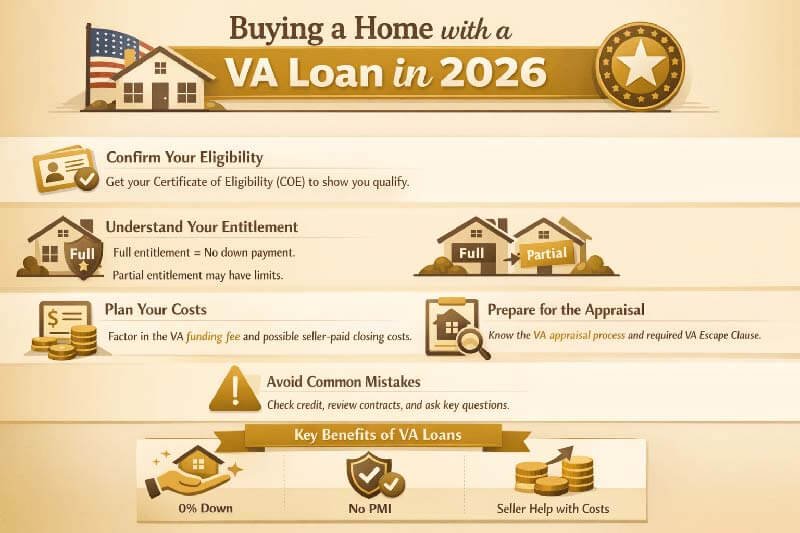
VA Loan Benefits Richmond Homebuyers Often Overlook
Most veterans and active-duty service members in Richmond know the headline VA loan benefits by heart: no down payment, no private mortgage insurance, and competitive interest rates. What far fewer buyers realize is that the VA loan program includes a second layer of lesser-known advantages provisions that can save thousands of dollars, simplify the homebuying process, or open doors that conventional and FHA loans simply don\’t offer. This guide walks through the VA loan benefits Richmond homebuyers most often overlook, along with a full FAQ section answering the questions veterans ask most.
1. The Funding Fee Exemption for Disabled Veterans
Every VA loan carries a one time funding fee that helps sustain the program, and the standard first-use purchase fee with no down payment sits at 2.15% for 2026. On a $400,000 home, that adds up to roughly $8,600 a cost many buyers simply budget for without realizing they might not have to pay it at all. VA Loan Benefits Richmond.
Veterans with a service connected disability rating of 10% or higher are fully exempt from the funding fee, and surviving spouses receiving Dependency and Indemnity Compensation (DIC), along with Purple Heart recipients on active duty, also pay nothing. Many eligible veterans in Richmond never file the paperwork to claim this exemption simply because they don\’t know it exists, and end up paying a fee they were never required to pay.
2. A Down Payment Can Still Lower Your Costs Even Though You Don\’t Need One
The zero-down-payment feature is the most famous VA loan benefit, but it can create a blind spot: buyers assume putting money down offers no advantage. In reality, a 5% down payment drops the funding fee from 2.15% to 1.50%, and a 10% down payment lowers it further to 1.25%. On a $300,000 purchase, moving from 0% down to 5% down saves nearly $2,000 in funding fee costs alone money that can be worth putting toward closing costs instead, depending on a buyer\’s cash reserves.
3. Sellers Can Cover More Than You\’d Expect
VA loans allow sellers to contribute toward a buyer\’s costs in ways conventional loans restrict more tightly. Sellers can pay up to 4% of the purchase price toward buyer concessions including the funding fee and prepaid items while also covering standard closing costs separately outside that cap. In a Richmond market where negotiation room varies by neighborhood and season, this is a benefit many buyers never ask for because they don\’t realize it\’s available. Some veterans negotiate for the seller to pay the funding fee in cash at closing entirely, preserving their full no-down-payment benefit while still keeping their loan balance at the actual purchase price.
4. You Can Finance the Funding Fee Instead of Paying Cash
Most borrowers have the option to roll the VA funding fee directly into the loan amount rather than paying it out of pocket at closing. This flexibility can make the difference between closing on a home now versus waiting months to save additional cash though it\’s worth noting that financing the fee increases the total loan balance and the interest paid over time, so it\’s a trade-off worth discussing with a lender familiar with Richmond-area pricing.
5. VA Loans Can Be Used More Than Once
A surprising number of veterans believe the VA loan benefit is a one-time-only perk, used up the moment they buy their first home. That\’s a myth. Veterans can use their entitlement multiple times over their lifetime, and in some circumstances can even hold more than one VA loan simultaneously. The catch: using the benefit a second or later time raises the standard funding fee to 3.30% with no down payment, so it\’s worth planning ahead if a move or upgrade is likely in Richmond\’s future.
6. Restoring Entitlement Doesn\’t Reset Your Fee Tier
This is a nuance that trips up even experienced buyers. If a veteran pays off a prior VA loan and restores their entitlement, they don\’t return to first-use funding fee rates subsequent-use rates still apply. Knowing this ahead of time helps Richmond veterans budget accurately for a second purchase rather than being surprised at the closing table.
7. No Monthly Mortgage Insurance, Ever
Unlike FHA loans, which charge both an upfront premium and an ongoing monthly mortgage insurance cost, VA loans charge only the one-time funding fee with no monthly insurance requirement at all. On a $300,000 loan, FHA borrowers pay thousands upfront plus a couple hundred dollars a month in insurance, while VA borrowers pay a single fee and nothing more a difference that compounds significantly over a 15- or 30-year mortgage term.
8. The Funding Fee May Be Tax-Deductible
Starting with the 2026 tax year, VA borrowers are permitted to deduct the funding fee on their taxes when purchasing a home with a VA-backed mortgage, provided they itemize deductions. This is a benefit few Richmond buyers factor into their overall cost comparison against conventional financing, and it\’s worth a conversation with a tax professional at filing time.
9. Guard and Reserve Members Have Access Too
VA loan eligibility isn\’t limited to veterans who served on active duty for years. Members of the National Guard and Reserves can also qualify, generally after six years of qualifying service, opening the door to zero-down financing for a segment of the military community that sometimes assumes VA benefits don\’t apply to them.
10. Local Appraisal Knowledge Matters More Than Buyers Expect
VA loans require the home to meet Minimum Property Requirements (MPRs) during appraisal a step that can create friction in a city like Richmond with a large stock of older homes in historic districts. Buyers who work with a lender and agent experienced in Richmond\’s housing stock are far less likely to see a contract fall through over appraisal surprises, a benefit that has nothing to do with fees but can save an entire transaction.
Why This Matters for Richmond Veterans Specifically
Richmond\’s proximity to major military installations means a large share of local homebuyers are VA-eligible, yet many still shop for homes using a conventional-loan mindset assuming a bigger down payment always helps, that the process takes longer, or that sellers are hesitant to accept VA offers. None of that reflects how VA loans actually work in 2026. Understanding the full scope of these benefits not just the headline features often makes the difference between a stressful purchase and a smooth, cost-effective one.
Frequently Asked Questions
1. What is the VA funding fee in 2026?
Purchase fees range from 1.25% to 3.30% depending on down payment and prior use, while IRRRL refinances carry a 0.50% fee.
2. Who is exempt from the VA funding fee?
Veterans with a service-connected disability rating of 10% or higher, surviving spouses receiving DIC, and Purple Heart recipients on active duty are exempt entirely.
3. Does a down payment lower the funding fee even though it\’s not required?
Yes. Putting down 5% lowers the fee to 1.50%, and 10% or more brings it down to 1.25%.
4. Can I use a VA loan more than once?
Yes, veterans can reuse their VA loan entitlement multiple times, though the funding fee is typically higher on subsequent uses.
5. If I restore my entitlement, do I get first-time rates again?
No restoring entitlement after paying off a prior VA loan still applies subsequent-use funding fee rates.
6. Can I finance the funding fee instead of paying it upfront?
Yes, most borrowers can roll the fee into their loan balance rather than paying cash at closing.
7. Is the VA funding fee tax-deductible?
Starting in the 2026 tax year, the funding fee is deductible for borrowers who itemize, subject to IRS filing requirements.
8. How much can a seller contribute toward my VA loan costs?
Sellers can contribute up to 4% of the purchase price toward concessions, in addition to paying standard closing costs separately.
9. Do VA loans require monthly mortgage insurance?
No. VA loans never carry a monthly mortgage insurance premium, unlike FHA loans.
10. Are National Guard and Reserve members eligible for VA loans?
Yes, generally after six years of qualifying service, or under certain activation circumstances.
11. What is the funding fee on a $400,000 VA loan?
For a first-time purchase with no down payment, the fee comes to about $8,600.
12. How is the funding fee different for a refinance?
IRRRL streamline refinances carry a flat 0.50% funding fee, separate from purchase-loan rates.
13. What happens on a cash-out refinance funding fee?
Cash out refinances are charged at the same rate as a 0% down purchase 2.15% for first use and 3.3% for subsequent use regardless of home equity.
14. Do VA loans take longer to close than conventional loans?
No with an experienced VA lender, timelines are typically comparable to conventional and FHA closings.
15. Why does local Richmond knowledge matter for a VA loan?
Because VA appraisals apply Minimum Property Requirements that can be affected by a home\’s age and condition common in Richmond\’s historic housing stock a lender and agent familiar with the local market can help avoid appraisal-related delays or surprises.
#VALoan #RichmondVA #VeteranHomebuyers #MilitaryFamilies #VALoanBenefits #MortgageTips2026 #RichmondRealEstate #ZeroDownMortgage #VeteranOwned #HomeBuyingTips #VAFundingFee #FirstTimeHomeBuyer #RichmondVirginia #MortgageGuide #VeteranHomeownership