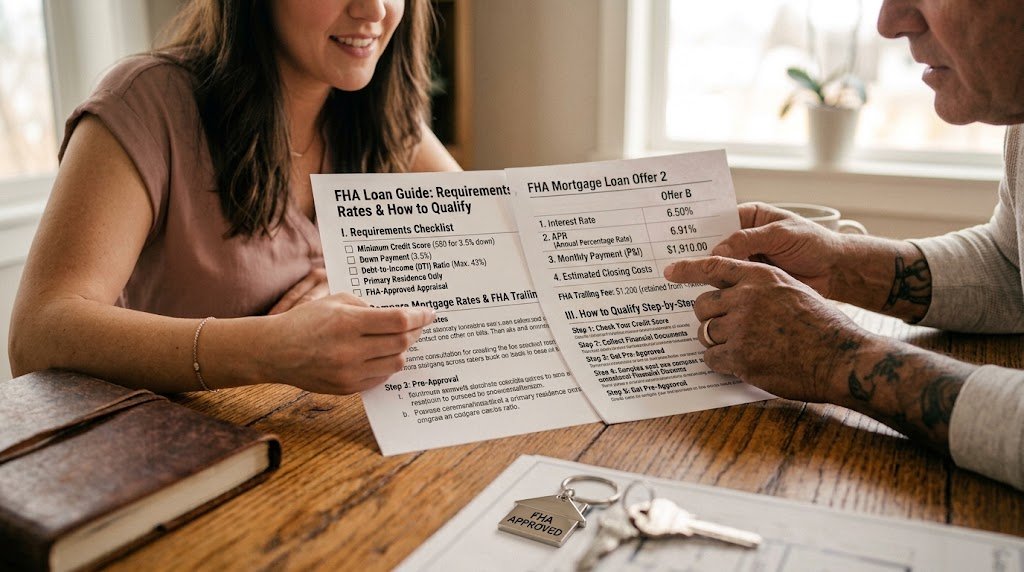
FHA Loan Guide: Requirements, Rates & How to Qualify starts with a simple idea: an FHA loan can make buying a home possible for borrowers who may not have the credit profile or savings required for some conventional mortgages. FHA loans are issued by private lenders and insured by the Federal Housing Administration, part of the U.S. Department of Housing and Urban Development (HUD).
For many buyers, the headline attraction is a down payment as low as 3.5% when the borrower meets the applicable credit requirements. But qualifying involves more than a credit score. Your income, debts, employment history, available funds, property, loan amount, and mortgage insurance all affect the final approval.
This 2026 guide breaks down FHA loan requirements in plain English, explains how FHA rates work, covers mortgage insurance and loan limits, and shows how to prepare before applying.

What Is an FHA Loan and How Does It Work?
An FHA loan is a mortgage insured by the Federal Housing Administration. The FHA does not normally lend the money directly to the borrower. Instead, approved private lenders originate the mortgage, while FHA insurance reduces the lender\’s risk.
That structure allows FHA financing to accommodate borrowers who may have:
- A smaller down payment
- Less-than-perfect credit
- Limited cash reserves
- A higher debt-to-income ratio than some conventional programs allow
- A need for flexible qualification guidelines
The FHA\’s standard purchase mortgage is commonly associated with the 203(b) program. FHA also offers specialized programs, including FHA 203(k) financing for eligible home renovations.
An FHA mortgage is not automatically the cheapest mortgage available. Buyers with stronger credit and larger down payments may find that conventional financing offers lower long-term costs, particularly because FHA loans carry mortgage insurance.
The right comparison is therefore not simply “FHA versus conventional.” It is which loan gives you the strongest combination of payment, upfront cash requirement, insurance cost, and long-term affordability?
FHA Loan Requirements: What Do You Need to Qualify?
The most important FHA requirements involve credit, down payment, income, debt, occupancy, and the property itself.
1. Credit Score
FHA guidelines generally allow:
- 580 or higher: potentially eligible for the 3.5% minimum down payment.
- 500–579: potentially eligible with a 10% down payment.
- Below 500: generally does not meet the FHA minimum credit-score requirement.
These are FHA baseline guidelines. A lender can impose additional requirements, sometimes called overlays, so meeting the FHA minimum does not guarantee approval. The National Association of REALTORS® summarizes the same 580/3.5% and 500–579/10% framework.
2. Down Payment
With qualifying credit, an FHA borrower may purchase a home with as little as 3.5% down.
For a $300,000 home:
$300,000 × 3.5% = $10,500
That leaves a base purchase loan of approximately $289,500 before considering applicable financing adjustments and other transaction costs.
A 3.5% down payment does not mean you need exactly $10,500 in your bank account. Depending on the transaction, eligible sources of funds may include gifts or other permitted assistance, subject to FHA and lender rules.
3. Employment and Income
There is no universal FHA rule saying every borrower must earn a particular dollar amount.
Instead, lenders evaluate whether your income is sufficient, stable, documentable, and likely to continue.
Your lender may request:
- Pay stubs
- W-2 forms
- Tax returns
- Bank statements
- Employment verification
- Documentation for additional income
Self-employed borrowers can qualify, but documenting income can be more involved. PNC notes that self-employed FHA borrowers may use documented income, including information from tax returns, subject to qualification requirements.
4. Debt-to-Income Ratio
Your debt-to-income ratio (DTI) compares your recurring monthly debt obligations with your gross monthly income.
For example, if qualifying monthly debts total $2,400 and gross monthly income is $6,000:
$2,400 ÷ $6,000 = 40% DTI
A common FHA benchmark is 43%, but that number should not be treated as an absolute approval cutoff. FHA underwriting can allow different qualifying ratios depending on credit, automated underwriting findings, compensating factors, and other circumstances. HUD\’s underwriting handbook contains multiple ratio scenarios rather than one universal DTI ceiling.
This is an important distinction because simply saying “FHA requires a 43% DTI” can be misleading.
FHA Debt-to-Income Ratio Guide
FHA Loan Guide: How Much Can You Borrow in 2026?
FHA loan limits vary by location and property size.
For 2026, HUD established the following nationwide forward mortgage limits:
| Property | Low-Cost Area Floor | High-Cost Area Ceiling |
|---|---|---|
| 1 unit | $541,287 | $1,249,125 |
| 2 units | $693,050 | $1,599,375 |
| 3 units | $837,700 | $1,933,200 |
| 4 units | $1,041,125 | $2,402,625 |
These limits apply to FHA case numbers assigned on or after January 1, 2026, and individual counties can fall between the national floor and ceiling.
That means you should not assume that the $541,287 one-unit floor applies to every U.S. county.
A buyer in a high-cost area may have a substantially higher FHA loan limit.
Practical tip: Before making an offer, check the FHA loan limit for the specific county where the property is located.
FHA Loan Limits by State and County
How Do FHA Mortgage Rates Work?
FHA mortgage rates change with market conditions and lender pricing.
There is no single nationwide “FHA rate” that every borrower receives.
Your actual rate can depend on factors such as:
- Credit profile
- Loan amount
- Down payment
- Property type
- Loan term
- Market conditions
- Lender pricing
- Discount points
PNC similarly notes that FHA rates fluctuate with the market and that FHA rates can sometimes be lower than conventional rates, but this is not guaranteed for every borrower.
FHA Rate vs. FHA APR
Do not compare mortgage offers using the interest rate alone.
The interest rate represents the rate used to calculate interest on the mortgage.
The APR incorporates certain interest and finance charges and can provide a broader basis for comparing loan offers.
When shopping, ask each lender for the same loan scenario and compare:
- Interest rate
- APR
- Points
- Origination charges
- Mortgage insurance
- Estimated cash to close
- Total monthly payment
This produces a much more useful comparison than asking several lenders for their “best FHA rate” without giving them the same borrower and loan scenario.

FHA Mortgage Insurance: The Cost Buyers Often Underestimate
Mortgage insurance is one of the biggest differences between FHA and many conventional mortgages.
FHA loans generally involve two forms of mortgage insurance:
Upfront Mortgage Insurance Premium
The standard upfront mortgage insurance premium (UFMIP) is 1.75% of the base loan amount for most FHA forward mortgages.
For example, if the base FHA loan amount were $289,500:
$289,500 × 1.75% = $5,066.25
The upfront premium can generally be financed into the mortgage rather than paid entirely in cash at closing. HUD confirms the 1.75% standard UFMIP structure.
Annual Mortgage Insurance Premium
FHA borrowers also generally pay an annual MIP that is collected through monthly payments.
The applicable amount varies according to factors such as:
- Loan term
- Loan amount
- Loan-to-value ratio
HUD\’s current MIP guidance lists different annual premium ranges based on these factors.
This is why a buyer comparing an FHA loan with a conventional loan should compare the full monthly payment, not just principal and interest.
What Properties Can You Buy With an FHA Loan?
FHA financing is primarily intended for owner-occupied primary residences.
Eligible property types can include:
- Single-family homes
- Certain condominiums
- Two-unit properties
- Three-unit properties
- Four-unit properties
- Certain eligible manufactured homes
- Certain properties using specialized FHA programs
The property must meet applicable FHA requirements.
For example, FHA appraisal requirements are concerned with whether the property meets minimum standards relating to safety, security, and soundness.
Can You Buy a Fixer-Upper?
Potentially.
The FHA 203(k) program can combine home purchase or refinancing with eligible renovation financing. This can be useful when a property needs improvements that would otherwise make traditional financing more difficult.
However, 203(k) financing has additional rules, documentation, contractor requirements, and project considerations.
FHA 203(k) Renovation Loan Guide
FHA Loan Guide: How to Qualify Step by Step
Getting ready before applying can make the mortgage process considerably smoother.
Step 1: Check Your Credit
Review your credit reports and scores before applying.
Look for:
- Incorrect accounts
- Late-payment reporting errors
- High credit-card balances
- Collections or disputed debts
- Recent new credit
Don\’t make major credit changes immediately before closing without discussing them with your lender.
Step 2: Calculate Your Debts
Write down your recurring monthly obligations.
Include:
- Auto loans
- Student loans
- Credit cards
- Personal loans
- Child support or other qualifying obligations
- Existing housing payments
Then compare your debts with gross monthly income.
Step 3: Estimate Your Available Cash
Your cash requirement can include more than the down payment.
Budget for:
- Down payment
- Closing costs
- Prepaid taxes
- Homeowners insurance
- Initial escrow funding
- Inspection expenses
- Moving costs
- Reserves, if applicable
This is one area where a “3.5% down” headline can create unrealistic expectations if the buyer does not budget for the rest of the transaction.
Step 4: Get Pre-Approved
A pre-approval helps you understand your likely purchasing range before you begin making offers.
A lender will review your financial information and provide an estimate of what you may qualify for, subject to further underwriting.
Step 5: Compare FHA With Conventional Financing
Don\’t assume FHA is automatically better because the down payment is smaller.
Compare:
- Monthly payment
- Upfront cash
- Mortgage insurance
- Interest rate
- APR
- Closing costs
- Long-term cost
Step 6: Find an Eligible Property
Once you\’re pre-approved, work with your real estate professional to identify properties that fit your budget and financing requirements.
Step 7: Complete Underwriting and Appraisal
After an offer is accepted, the lender reviews the loan and the property goes through the required appraisal process.
The appraisal is not the same thing as a full home inspection. Buyers should consider obtaining an independent inspection as well.
Step 8: Review Your Closing Disclosure
Before closing, carefully review your final loan terms and costs.
Confirm that the:
- Interest rate
- Loan amount
- Monthly payment
- Closing costs
- Cash to close
match your expectations.
Mortgage Pre-Approval Step-by-Step Guide
FHA Loan Benefits and Drawbacks
Benefits
An FHA mortgage may be attractive because it offers:
- Down payments as low as 3.5% for qualifying borrowers
- More flexible credit guidelines
- Government insurance that supports lender participation
- Financing options for certain multi-unit properties
- Specialized programs such as 203(k)
- Potentially competitive interest rates
Drawbacks
FHA financing also has disadvantages:
- Upfront mortgage insurance
- Ongoing mortgage insurance
- FHA property requirements
- Loan limits
- Potentially higher long-term costs than conventional financing for some borrowers
- A more involved property eligibility process in certain situations
The key is to evaluate the entire loan, not one attractive feature.
FHA vs. Conventional Loan: Which Is Better?
There is no universal winner.
An FHA loan can make sense when the borrower values a lower minimum down payment or more flexible credit guidelines.
A conventional mortgage may be more attractive for a borrower with strong credit, sufficient savings, and a desire to reduce mortgage insurance costs.
A simple comparison might look like this:
| Factor | FHA | Conventional |
| Minimum down payment | As low as 3.5% for qualifying borrowers | Can be as low as 3% for some programs |
| Credit flexibility | Generally more flexible | Varies by program |
| Mortgage insurance | FHA MIP generally applies | PMI may apply depending on LTV |
| Loan limits | County-specific FHA limits | Conventional conforming limits apply |
| Property standards | FHA requirements apply | Conventional appraisal requirements apply |
| Best fit | Buyers needing FHA\’s flexible structure | Buyers who may benefit from conventional pricing |
The actual choice depends on the borrower\’s financial profile.
Original Example: Why the Cheapest Rate May Not Be the Cheapest Loan
Consider two hypothetical offers for a buyer financing approximately $290,000.
Offer A
- Slightly lower interest rate
- Higher discount points
- Higher upfront cost
Offer B
- Slightly higher interest rate
- Lower points
- Lower cash required at closing
If the buyer expects to keep the mortgage for many years, Offer A could potentially save more through the lower rate.
But if the buyer expects to refinance or move relatively soon, paying substantially more upfront for that rate reduction may not make financial sense.
This illustrates a useful rule:
A mortgage rate should always be evaluated alongside the cost of obtaining that rate and the expected time you will keep the loan.
That comparison is more useful than simply choosing whichever advertisement displays the smallest percentage.
FHA Loan Guide: Common Mistakes to Avoid
Mistake 1: Assuming 3.5% Is Your Total Cash Requirement
The down payment is only one part of the transaction.
Mistake 2: Treating 43% DTI as an Absolute Rule
FHA underwriting can involve different qualifying ratios depending on the borrower\’s circumstances and underwriting method.
Mistake 3: Ignoring Mortgage Insurance
The lower down payment can come with ongoing MIP costs.
Mistake 4: Shopping Only by Interest Rate
A lower rate with higher points is not necessarily the best deal.
Mistake 5: Assuming All Lenders Have Identical Requirements
Lenders can apply overlays beyond baseline FHA requirements.
Mistake 6: Forgetting 2026 Loan Limits
Your maximum FHA loan amount depends on the property\’s location and number of units.
Is an FHA Loan Right for You in 2026?
An FHA loan may be a strong option if you want a relatively low down payment and need more flexible credit or underwriting guidelines.
It may be less attractive if you have excellent credit, substantial savings, and can qualify for a conventional mortgage with lower overall insurance costs.
Before choosing, compare at least two scenarios:
Scenario A: FHA with 3.5% down
Scenario B: Conventional financing with the down payment and pricing available to you
Compare the monthly payment, cash to close, mortgage insurance, interest rate, APR, and estimated long-term cost.
For official program information, use HUD\’s FHA resources and the FHA Single Family Housing Policy Handbook rather than relying solely on advertisements or generic online calculators. HUD\’s 2026 loan-limit announcement confirms that the one-unit FHA national floor is $541,287 and the high-cost ceiling is $1,249,125.
Conclusion
The FHA program can open the door to homeownership for buyers who may not fit conventional mortgage guidelines as comfortably.
The biggest advantages are the potential 3.5% down payment, flexible credit structure, and broad availability through FHA-approved lenders. The biggest considerations are mortgage insurance, property requirements, loan limits, and the total cost of borrowing.
If you\’re considering an FHA mortgage in 2026, start by checking your credit, calculating your debts, estimating your available cash, and reviewing the FHA loan limit for your county.
Then compare FHA and conventional financing using real loan estimates—not just advertised rates.
CTA: Ready to explore your home financing options? Talk with a qualified mortgage professional to compare FHA and conventional scenarios based on your actual income, credit, down payment, and home price.
3. FAQ Section
What is an FHA loan?
An FHA loan is a mortgage originated by an FHA-approved private lender and insured by the Federal Housing Administration. It is designed to provide more flexible financing options for eligible homebuyers.
What credit score do you need for an FHA loan?
FHA guidelines generally allow a 3.5% down payment for borrowers with a minimum decision credit score of 580. Borrowers with scores from 500 to 579 may qualify with a 10% down payment, subject to applicable requirements and lender approval.
How much is the FHA down payment?
Eligible borrowers can potentially make a down payment as low as 3.5% of the purchase price. For a $300,000 home, that equals $10,500.
What are the FHA loan limits for 2026?
For 2026, the nationwide FHA one-unit loan-limit floor is $541,287 and the high-cost ceiling is $1,249,125. Limits vary by county and property size.
Does an FHA loan require mortgage insurance?
Yes. Most FHA forward mortgages require an upfront mortgage insurance premium and an annual mortgage insurance premium paid over time. HUD states that the standard upfront MIP is 1.75% of the base loan amount.
Is an FHA loan better than a conventional loan?
Not necessarily. FHA can be advantageous for borrowers who need a smaller down payment or more flexible qualification criteria, while conventional financing can be less expensive for some borrowers with stronger credit and larger down payments. Comparing actual loan estimates is the best way to decide.