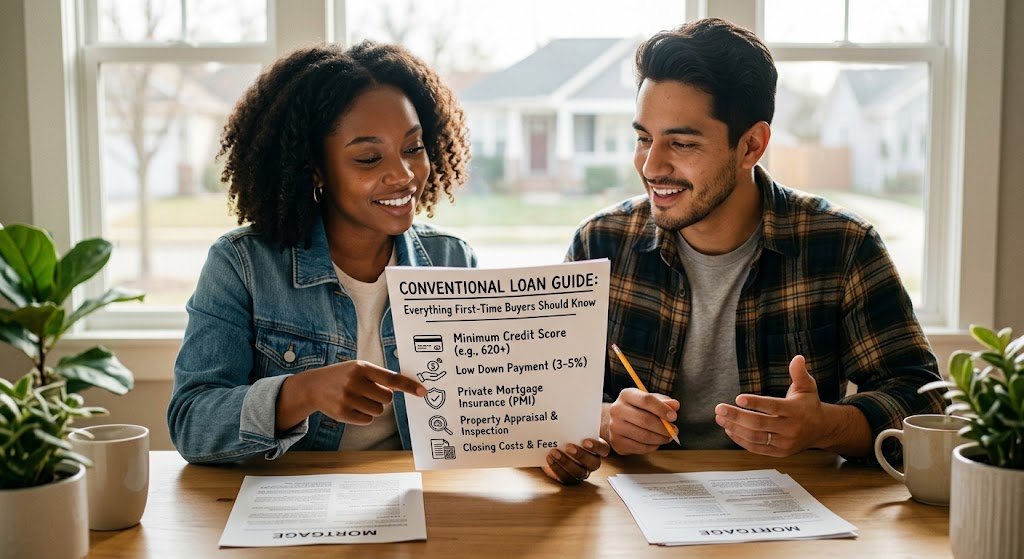
Conventional Loan Guide: Everything First-Time Buyers Should Know starts with one important fact: a conventional mortgage is not a government-insured loan such as an FHA loan. Instead, conventional mortgages are generally offered by private lenders, with many conforming loans eligible for purchase or backing through Fannie Mae or Freddie Mac.
For first-time buyers, that distinction matters because conventional financing can offer flexible down-payment options, competitive pricing for qualified borrowers, and the potential to cancel private mortgage insurance (PMI). But approval depends on more than simply having a good credit score.
Your lender will look at your credit history, income, debts, assets, down payment, property, loan amount, and overall ability to repay.
This guide breaks down the process in plain English so you can understand what conventional financing means, how much you may need to put down, how PMI works, what affects your mortgage rate, and how to prepare before applying.
 Conventional Loan Guide: Everything First-Time Buyers Should Know about mortgage approval
What Is a Conventional Loan?
A conventional loan is a mortgage that is not part of a specific government loan program.
That makes it different from:
- FHA loans, which are insured by the Federal Housing Administration
- VA loans, which are guaranteed by the Department of Veterans Affairs
- USDA loans, which are backed through the U.S. Department of Agriculture
Conventional mortgages can be either conforming or non-conforming.
Conforming conventional loans
A conforming loan meets applicable requirements established for loans eligible for purchase by Fannie Mae or Freddie Mac.
The 2026 baseline conforming loan limit for a one-unit property in most U.S. counties is $832,750. In designated high-cost areas, the one-unit limit can rise to $1,249,125. Alaska, Hawaii, Guam, and the U.S. Virgin Islands have separate higher limits.
Non-conforming conventional loans
A conventional mortgage that exceeds applicable conforming limits is generally considered non-conforming. Jumbo loans are a common example.
The key takeaway for a first-time buyer is simple: your purchase price does not determine whether your mortgage is conforming—the loan amount and applicable county limit matter.
What Is a Conventional Mortgage?
Conventional Loan Requirements for First-Time Buyers
One of the biggest mistakes first-time buyers make is assuming there is one universal conventional-loan checklist.
There isn\’t.
Lenders can have different underwriting standards, and eligibility can also depend on the specific Fannie Mae or Freddie Mac program being used.
Still, lenders commonly evaluate several major areas.
1. Credit history
Credit is important because it helps lenders assess how you\’ve handled borrowed money in the past.
A 620 credit score is often cited as a common minimum benchmark, but it should not be treated as a universal approval rule. Some programs, lenders, or borrower circumstances can differ.
A stronger credit profile may help you qualify for better pricing.
Before applying, review your credit reports for:
- Incorrect account information
- Late payments that were reported inaccurately
- Accounts you don\’t recognize
- Outdated information
- Excessive new credit inquiries
Don\’t assume you need perfect credit. The goal is to understand your profile and address legitimate problems before applying.
2. Income and employment
Your lender needs evidence that your income is sufficient and reasonably reliable for the proposed payment.
Depending on your circumstances, documentation can include:
- Pay stubs
- W-2 forms
- Tax returns
- Bank statements
- Employment verification
- Business records for self-employed borrowers
Self-employed applicants may face additional documentation requirements because lenders need to understand the stability and consistency of qualifying income.
3. Debt-to-income ratio
Your debt-to-income ratio (DTI) compares your monthly debt obligations with your gross monthly income.
For example, if qualifying monthly income is $8,000 and monthly debts total $3,200:
$3,200 ÷ $8,000 = 40% DTI
A lower DTI can strengthen an application because it indicates that less of your income is already committed to debt.
However, DTI limits are not identical for every borrower or loan scenario. Your lender will evaluate the complete application rather than relying on one number.
How Much Down Payment Do You Need?
A major advantage of conventional financing is that you may not need 20% down.
Some conventional programs can allow down payments as low as 3% for eligible borrowers. The CFPB confirms that conventional loans backed by Fannie Mae or Freddie Mac can require as little as 3% down in certain circumstances.
Consider a hypothetical $350,000 home:
| Down payment | Approximate amount |
|---|---|
| 3% | $10,500 |
| 5% | $17,500 |
| 10% | $35,000 |
| 20% | $70,000 |
These numbers show why a first-time buyer shouldn\’t automatically assume that waiting until they have $70,000 is necessary.
However, a smaller down payment can increase your loan balance and may result in PMI.
Should you put 20% down?
Not necessarily.
A larger down payment can reduce the amount borrowed and may eliminate PMI, but using every dollar of savings for the down payment can leave you with little cash for emergencies, repairs, moving expenses, or other homeownership costs.
The better question is:
What down payment leaves me financially comfortable after closing?
 Conventional Loan Guide: Everything First-Time Buyers Should Know about down payment options
What Is PMI on a Conventional Loan?
Private mortgage insurance (PMI) is insurance that protects the lender—not the borrower—when required on a conventional mortgage.
If you put less than 20% down, PMI is commonly required, although the exact structure depends on the loan and lender.
PMI can be paid in different ways depending on the mortgage structure.
The important point is that PMI isn\’t automatically a reason to avoid conventional financing.
In fact, PMI can allow a qualified buyer to purchase a home without saving a 20% down payment.
Can PMI be removed?
One of the attractive features of conventional financing is that PMI may be cancellable when applicable requirements are met.
Fannie Mae notes that borrowers can generally request cancellation when they reach the required equity threshold, subject to applicable conditions.
This is different from mortgage-insurance structures on some government-backed loans.
How Do Conventional Mortgage Rates Work?
There is no single conventional mortgage rate that every first-time buyer receives.
Your offered rate can depend on factors such as:
- Credit profile
- Down payment
- Loan amount
- Loan term
- Property type
- Occupancy
- Market conditions
- Loan program
- Discount points
- Overall risk profile
That\’s why comparing two advertised mortgage rates without looking at the complete loan terms can be misleading.
Interest rate vs. APR
The interest rate is the percentage used to calculate interest on the mortgage.
APR goes further by incorporating certain loan costs, making it useful when comparing offers with different fees.
Fannie Mae specifically recommends looking at APR as well as the interest rate because two lenders can offer the same interest rate while charging different costs.
Understanding Mortgage Rates and APR
Conventional Loan Costs First-Time Buyers Should Budget For
The down payment isn\’t your only upfront expense.
A realistic home-buying budget may include:
- Down payment
- Lender origination charges
- Appraisal
- Credit report
- Title services
- Recording or government fees
- Prepaid interest
- Property taxes
- Homeowners insurance
- Escrow funding
- Inspection costs
- Moving expenses
- Immediate repairs
The CFPB notes that closing costs can include origination charges, appraisal fees, credit-report costs, title insurance, and other mortgage-related expenses. These costs are summarized in the Loan Estimate provided during the mortgage process.
Don\’t forget the cash-reserve question
Here\’s a practical example that deserves more attention than it gets:
Imagine a buyer has exactly $35,000 saved and wants to make a $30,000 down payment.
Technically, the buyer may have enough for the down payment.
Financially, however, closing with only $5,000 remaining could be uncomfortable.
A broken HVAC system, emergency repair, insurance bill, or unexpected moving expense could quickly consume that cushion.
Being able to qualify for a mortgage and being financially ready to own the home are two different questions.
That distinction is one of the most important lessons for first-time buyers.
Conventional Loan vs. FHA: Which Is Better?
Neither loan is automatically better for everyone.
A conventional mortgage may be attractive when you have a stronger credit profile and want the potential for cancellable PMI.
An FHA loan may be attractive to buyers who need more flexible qualification criteria or a smaller down payment under applicable rules.
The CFPB explains that conventional loans can sometimes have lower costs than FHA loans, but conventional financing can also be more difficult to qualify for.
| Feature | Conventional | FHA |
|---|---|---|
| Government-backed? | No | Yes |
| Potential low down payment | Yes | Yes |
| Mortgage insurance | PMI when applicable | FHA mortgage insurance |
| PMI cancellation | Possible when requirements are met | Different FHA rules apply |
| Credit requirements | Vary by lender/program | Often more flexible |
| Best choice | Depends on borrower | Depends on borrower |
The right comparison should include total monthly payment, upfront costs, mortgage insurance, interest rate, fees, and long-term cost rather than simply asking which loan has the lowest down payment.
FHA Loan vs. Conventional Loan
How to Get a Conventional Loan: Step-by-Step
For first-time buyers, the process becomes easier when you break it into stages.
Step 1: Review your finances
Calculate:
- Gross monthly income
- Monthly debt payments
- Available savings
- Emergency reserves
- Estimated homeownership expenses
Step 2: Check your credit
Review your credit reports and correct legitimate errors before applying.
Avoid making major financial changes immediately before or during underwriting without discussing them with your lender.
Step 3: Determine a realistic price range
Don\’t base affordability solely on the maximum amount a lender says you can borrow.
Build your budget around a payment you can comfortably maintain.
Step 4: Compare lenders
The CFPB recommends shopping around and requesting loan offers that reflect the same loan type, term, and assumptions so you can make a meaningful comparison.
Compare:
- Interest rate
- APR
- Origination charges
- Discount points
- PMI
- Estimated closing costs
- Cash required to close
Step 5: Get pre-approved
A pre-approval can help you understand your potential purchasing range and demonstrate to sellers that you\’ve discussed financing with a lender.
It is not the same thing as final loan approval.
Step 6: Make an offer
Once you find a suitable property, your lender and real estate professionals can help coordinate the financing and purchase process.
Step 7: Complete underwriting
The lender verifies your financial information and evaluates the property and loan.
Step 8: Review your closing documents
Before signing, carefully review the final numbers and ask questions about anything that changed.
Common Conventional Loan Mistakes First-Time Buyers Should Avoid
Mistake #1: Assuming 20% down is mandatory
It isn\’t. Some conventional programs allow significantly less, including certain 3%-down options.
Mistake #2: Shopping by rate alone
A low advertised rate can come with points or other costs.
Compare the complete loan offer.
Mistake #3: Ignoring PMI
If you\’re putting less than 20% down, ask exactly how PMI will affect your payment and when it may be cancellable.
Mistake #4: Spending every dollar on the down payment
Homeownership requires cash beyond the initial purchase.
Mistake #5: Assuming all lenders use identical requirements
Lenders can impose their own requirements in addition to applicable program guidelines.
Mistake #6: Confusing pre-approval with guaranteed financing
A pre-approval is an important step, but your loan still must go through the required underwriting and closing process.
2026 Conventional Loan Limits: What Buyers Should Know
Loan limits are particularly important in 2026 because FHFA increased the baseline conforming loan limit.
For a one-unit property, the 2026 baseline limit is $832,750, while the high-cost-area ceiling is $1,249,125 in the continental U.S. under the applicable formula.
But don\’t use the national number as your final answer.
Loan limits vary by county and property type.
Before making an offer, check the applicable limit for the county where you\’re buying.
Check the 2026 FHFA Conforming Loan Limits
Is a Conventional Loan Good for First-Time Buyers?
A conventional mortgage can be an excellent option for first-time buyers, particularly those with solid credit, stable income, manageable debt, and enough savings to handle the purchase without becoming financially stretched.
Its advantages can include:
- Down payments as low as 3% for eligible programs
- Competitive pricing for qualified borrowers
- Multiple loan terms
- Potentially cancellable PMI
- Broad availability
- Conventional financing for primary residences and other eligible property types
But it isn\’t automatically the right answer.
A first-time buyer should compare conventional financing against FHA, VA, USDA, or other available programs based on eligibility and total cost, not simply the advertised interest rate.
Consumer Financial Protection Bureau: Conventional Loans
Final Takeaway
A conventional mortgage can give first-time buyers a flexible path to homeownership without requiring a 20% down payment.
The most important things to understand are credit, income, DTI, down payment, PMI, interest rate, APR, closing costs, and conforming loan limits.
The smartest approach is not to ask, “How much house will the lender approve me for?”
Instead, ask:
“What home payment can I comfortably afford while still keeping enough savings for the unexpected?”
That mindset can help turn a mortgage approval into a sustainable homeownership plan.
If you\’re preparing to buy your first home, use this guide as your starting point, then compare actual loan offers from multiple lenders before choosing your financing.
3. FAQ Section
What is a conventional loan?
A conventional loan is a mortgage that is not part of a specific government loan program. Many conforming conventional loans are eligible for purchase or backing through Fannie Mae or Freddie Mac.
What credit score do I need for a conventional loan?
A 620 score is commonly used as a benchmark by many lenders, but there is no single universal minimum for every conventional loan. Requirements vary by lender, program, and borrower profile.
Can a first-time buyer get a conventional loan with 3% down?
Yes. Certain conventional programs can allow eligible first-time buyers and other qualified borrowers to put as little as 3% down.
Do conventional loans require PMI?
PMI is commonly required when a conventional borrower puts less than 20% down, although the exact requirements and payment structure can vary. PMI may be cancellable when applicable requirements are satisfied.
What are the 2026 conventional loan limits?
The 2026 baseline conforming loan limit for a one-unit property is $832,750 in most U.S. counties. The limit can be higher in designated high-cost areas, with a one-unit ceiling of $1,249,125 in the continental U.S.
Is a conventional loan better than an FHA loan?
Neither is universally better. Conventional financing may be attractive to borrowers with stronger credit and the potential to cancel PMI, while FHA financing can provide an alternative for buyers who may benefit from its qualification structure. Compare the total costs and requirements for your situation.