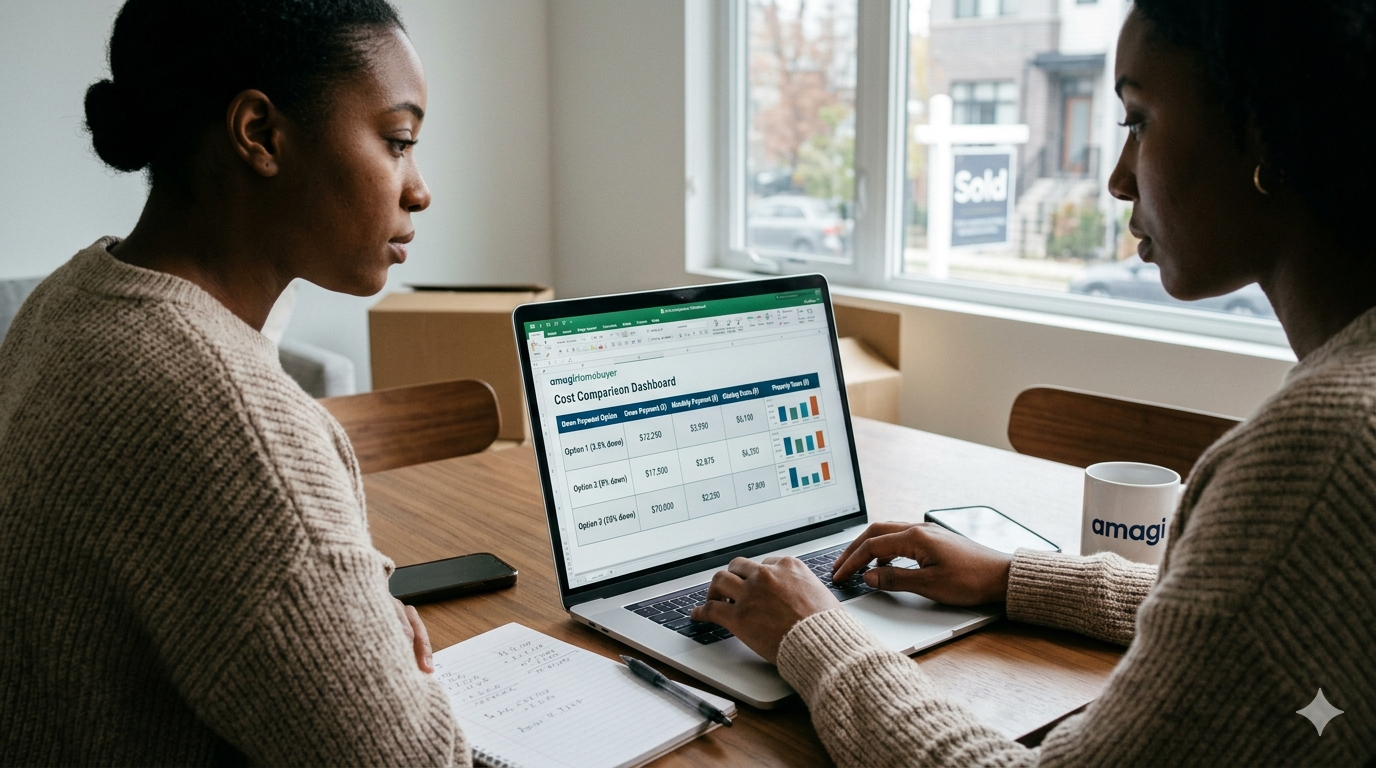
How Much House Can I Afford Based on My Income?
How Much House Can I Afford Based on My Income? Your affordable home price depends on more than your salary. Income, existing debt, down payment, mortgage rate, property taxes, homeowners insurance, HOA fees, and your other monthly expenses all affect the answer.
A quick starting point is to consider a home price around 3 to 5 times your annual household income, but that is only a broad estimate—not a guarantee that the payment will fit your budget. Fidelity uses this range as an initial guideline, while also emphasizing the importance of debt, mortgage rates, and future income.
The more useful question is not simply, “How much will a lender approve?” It is, “How much can I pay each month while still saving, handling emergencies, and paying for the rest of my life?” The Consumer Financial Protection Bureau (CFPB) makes the same important distinction: the amount you qualify to borrow can be different from the amount you can comfortably afford.

How Much Money Do I Need for a Down Payment on a House
How Much House Can I Afford Based on My Income?
A practical way to estimate your home-buying budget is to work backward from your gross monthly income and total monthly debt payments.
For example, suppose a household earns $100,000 per year.
- Gross monthly income: about $8,333
- Annual income: $100,000
- Existing monthly debt: $800
- Available cash for a down payment: $30,000
- Desired emergency savings: separate from the down payment
Using only the 3-to-5-times-income guideline would produce a rough home-price range of $300,000 to $500,000.
But those two prices do not create the same financial experience.
A $500,000 home could create a much larger monthly obligation once principal, interest, property taxes, homeowners insurance, mortgage insurance, and possible HOA costs are included. If the household also has car loans, student loans, credit-card payments, childcare, or other major expenses, the higher end of the range may be uncomfortable.
That is why income should be your starting point, not your final answer.
A simple income-based estimate
| Annual household income | 3× income | 4× income | 5× income |
|---|---|---|---|
| $50,000 | $150,000 | $200,000 | $250,000 |
| $75,000 | $225,000 | $300,000 | $375,000 |
| $100,000 | $300,000 | $400,000 | $500,000 |
| $125,000 | $375,000 | $500,000 | $625,000 |
| $150,000 | $450,000 | $600,000 | $750,000 |
| $200,000 | $600,000 | $800,000 | $1,000,000 |
These numbers are rough planning ranges, not mortgage approvals.
Your actual affordable price could be below or above them depending on your debt, credit, down payment, interest rate, taxes, insurance, and other financial obligations.
What Income Do Mortgage Lenders Count?
Mortgage lenders generally look at gross income, meaning income before federal and state taxes and other payroll deductions.
Depending on the loan and your circumstances, qualifying income may come from sources such as:
- Salary or hourly wages
- Bonuses
- Commissions
- Self-employment income
- Overtime
- Investment income
- Rental income
- Retirement income
- Certain government benefits
- Other documented recurring income
The important word is documented.
A lender generally wants evidence that the income is stable and can reasonably be expected to continue. The way variable income is evaluated can differ from how straightforward salary income is treated.
If you are self-employed, have substantial commissions, recently changed jobs, or have multiple income sources, the underwriting process may require additional documentation.
This is one reason an online affordability calculator can give you a useful estimate but cannot replace a lender\’s underwriting decision.
How Does Debt-to-Income Ratio Affect Home Affordability?
Your debt-to-income ratio (DTI) is one of the most important numbers in mortgage affordability.
DTI compares your monthly debt obligations with your gross monthly income.
The basic formula is:
DTI = Total Monthly Debt Payments ÷ Gross Monthly Income × 100
For example, if you earn $8,333 per month before taxes and have $2,500 in monthly debt obligations:
$2,500 ÷ $8,333 × 100 = 30% DTI
A lender may calculate DTI differently depending on the mortgage program and the specific debts included.
Fannie Mae notes that qualifying conventional borrowers can have a DTI as high as 50% in some circumstances, which illustrates an important point: the maximum amount a borrower can qualify for is not automatically the amount that is financially comfortable.
What counts as debt?
Depending on the lender and loan program, qualifying debts can include:
- Auto loans
- Student loans
- Credit-card minimum payments
- Personal loans
- Other mortgage payments
- Certain support obligations
- Other recurring debt obligations
But your personal budget contains more than qualifying debt.
You may also have:
- Groceries
- Childcare
- Utilities
- Health costs
- Transportation
- Retirement contributions
- Savings goals
- Travel
- Home maintenance
- Family expenses
A lender may not treat every one of these expenses the same way when determining your loan eligibility.
Your budget should.
What Monthly Payment Can I Comfortably Afford?
Instead of starting with a house price, start with a monthly payment.
Your total housing cost can include:
- Mortgage principal
- Mortgage interest
- Property taxes
- Homeowners insurance
- Mortgage insurance, if applicable
- HOA or condominium fees
- Other required property-related costs
This is sometimes called the PITI payment when referring to principal, interest, taxes, and insurance.
For example, imagine your household earns $8,333 gross per month.
You might decide that a housing payment around $2,300 feels reasonable based on your broader budget. Another household with exactly the same income might choose a lower amount because it has children, student loans, aggressive retirement goals, or irregular income.
That difference matters.
The “right” home price is not the largest number a calculator produces. It is the price that leaves enough room for the rest of your financial life.

Don\’t forget maintenance
One of the most commonly overlooked costs is home maintenance.
Renters generally call the landlord when something major breaks. Homeowners do not have that option.
A roof, HVAC system, plumbing problem, appliance replacement, exterior repair, or unexpected assessment can create a significant bill.
That means two homes with identical mortgage payments can have very different real-world affordability.
A newer home may have different maintenance needs than an older property. A condominium may have HOA fees and special assessments. A large house may cost more to heat, cool, insure, and maintain.
Your purchase price should therefore be evaluated alongside the total cost of ownership.
What Are the Closing Costs When Buying a Home
How Much House Can I Afford With a $50,000 Salary?
With a $50,000 annual income, a simple 3-to-5-times-income estimate gives a rough home-price range of:
$150,000 to $250,000
But this range should not be treated as a recommendation.
Suppose your gross monthly income is approximately $4,167.
If you have:
- $600 in car and student-loan payments
- Credit-card payments
- A small down payment
- Higher property taxes
- Higher homeowners insurance
then a $250,000 home may be much less comfortable than the income multiplier suggests.
If you have very little debt, a strong down payment, good credit, and relatively low property taxes, your situation could be different.
The key lesson is simple:
Income tells you how much you earn. Your complete budget tells you how much house you can afford.
How Much House Can I Afford With a $75,000 Salary?
At $75,000 per year, the broad 3-to-5-times-income range is:
$225,000 to $375,000
Your gross monthly income would be approximately $6,250.
At this income level, the difference between having $300 in monthly debt and $1,500 in monthly debt can dramatically change the amount of mortgage payment that fits comfortably into your budget.
You should also consider how much cash will remain after your down payment and closing costs.
A buyer who puts almost all available savings into a house may technically qualify for the purchase but become financially vulnerable immediately afterward.
Homeownership should not leave you with no emergency cushion.
How Much House Can I Afford With a $100,000 Salary?
With a $100,000 household income, the broad income-multiplier approach produces:
$300,000 to $500,000
Gross monthly income would be approximately $8,333.
Now consider two households with the same $100,000 income.
Household A
- $100,000 annual income
- $300 monthly car payment
- No student-loan payment
- $50,000 available for down payment and closing
- Strong emergency fund
Household B
- $100,000 annual income
- $700 car payment
- $600 student-loan payment
- $10,000 available for down payment and closing
- Limited emergency savings
Household A may be able to handle a significantly higher purchase price than Household B, even though their annual incomes are identical.
This is the kind of situation where a simple “4× your income” rule becomes misleading.
Original budgeting insight: Two buyers can earn exactly the same salary but have a six-figure difference in practical purchasing power when debt, cash reserves, and housing costs are considered together.
How Much Down Payment Do I Need?
You do not necessarily need 20% down to buy a home.
Fannie Mae notes that some conventional loans can allow down payments as low as 3%.
FHA loans can require as little as 3.5% down for eligible borrowers meeting the applicable requirements.
A larger down payment can reduce your loan amount and may reduce some mortgage costs, but putting more money down is not automatically better if it drains your emergency savings.
Example
Imagine a $400,000 home.
A 20% down payment would be:
$80,000
A 10% down payment would be:
$40,000
A 5% down payment would be:
$20,000
A 3.5% down payment would be:
$14,000
The financing costs and eligibility requirements can differ significantly between loan programs, so compare the complete loan terms rather than focusing only on the down-payment percentage.
You also need money for closing costs and prepaid expenses.
How Do Mortgage Rates Affect How Much House I Can Afford?
Mortgage rates have a direct effect on affordability because they affect your monthly principal-and-interest payment.
When rates rise, the same loan amount generally produces a higher monthly payment.
When rates fall, the same loan amount generally produces a lower monthly payment.
For example, a buyer may be comfortable with a $2,500 principal-and-interest payment. A change in mortgage rates can alter the loan amount that fits inside that payment.
But don\’t build your purchase decision around the hope that rates will fall later.
Buy the home based on the payment and financial situation you can reasonably manage now.
If refinancing becomes attractive later, that can be evaluated separately.
What Credit Score Do I Need to Afford a House?
Your credit score can affect your mortgage options, interest rate, mortgage insurance, and potentially the overall cost of borrowing.
There is no single credit-score number that determines whether everyone can buy a home.
Mortgage programs have different requirements, and lenders may apply their own underwriting standards.
A stronger credit profile can make borrowing less expensive, while a weaker profile may limit your options or increase costs.
Before applying, review:
- Credit reports
- Credit-card balances
- Payment history
- Outstanding debts
- Errors or inaccurate information
- Recent credit applications
For a U.S. borrower, it is also useful to distinguish between the credit score you see in a consumer app and the credit information or scoring models a mortgage lender actually uses.
What Credit Score Do I Need to Get a Mortgage
What Other Costs Should I Include in My Home Budget?
Your mortgage payment is only one part of homeownership.
Before deciding how much house you can afford, estimate the following.
Property taxes
Property taxes vary widely by location and property value.
A home with a lower purchase price can still have a substantial monthly housing cost if local property taxes are high.
Homeowners insurance
Insurance premiums vary based on location, property characteristics, coverage, insurer, and other factors.
In some areas, homeowners may also need separate coverage considerations for risks such as flooding.
HOA fees
If you buy a property governed by a homeowners association, monthly or annual HOA fees can increase your housing expenses.
Some communities may also charge special assessments.
Mortgage insurance
Depending on the loan structure and down payment, mortgage insurance may add to the monthly payment.
Utilities
A larger house can cost more to heat, cool, light, and maintain.
Maintenance and repairs
Budget for ongoing maintenance rather than assuming every dollar of your payment goes toward building equity.
Closing costs
Closing costs can include lender charges, title-related costs, recording fees, prepaid taxes and insurance, and other transaction expenses.
This is why a home advertised at a particular purchase price should never be evaluated using the purchase price alone.
Should I Use an Affordability Calculator?
Yes—but use it as a planning tool, not as a final answer.
Affordability calculators typically consider combinations of:
- Income
- Down payment
- Interest rate
- Loan term
- Property taxes
- Homeowners insurance
- Existing debts
- Other housing costs
Calculator.net, NerdWallet, and other financial websites provide affordability tools that can help buyers estimate a potential price range.
The best approach is to run several scenarios.
For example:
Scenario 1: 5% down
Scenario 2: 10% down
Scenario 3: 20% down
Then compare the resulting monthly payment and cash required at closing.
A useful calculator should help you answer:
“What happens to my monthly budget if I increase the purchase price by $25,000?”
That question is often more useful than simply asking for the maximum purchase price.
How to Calculate How Much House You Can Afford
Use this five-step process.
Step 1: Calculate gross monthly income
Take your annual household income and divide it by 12.
Example:
$120,000 ÷ 12 = $10,000 gross monthly income
Step 2: Add your recurring monthly debt
Suppose you have:
- Car loan: $500
- Student loan: $400
- Credit-card minimums: $200
Total:
$1,100 per month
Step 3: Establish a comfortable housing-payment target
Do not simply use the maximum a lender might permit.
Review your actual spending and savings goals first.
Step 4: Estimate the complete housing cost
Include:
- Principal
- Interest
- Taxes
- Insurance
- Mortgage insurance
- HOA fees
Step 5: Test the budget against real life
Ask:
- Can I still save for retirement?
- Can I maintain an emergency fund?
- Can I handle a major repair?
- Can I afford childcare or future family expenses?
- What happens if my income temporarily falls?
- Would I still be comfortable if taxes or insurance increase?
If the answer is no, lower the target purchase price.
What Is the 28/36 Rule for Home Affordability?
You may hear the 28/36 rule when researching mortgages.
Traditionally, the guideline suggests:
- Around 28% of gross monthly income for housing costs
- Around 36% of gross monthly income for total debt
However, these percentages should be treated as guidelines rather than universal guarantees.
Modern mortgage underwriting can allow higher debt ratios in some situations, while a financially conservative household may deliberately choose a lower ratio.
That is why relying on a single percentage can produce an incomplete answer.
The CFPB recommends focusing on what is affordable for your circumstances rather than simply targeting the maximum loan amount a lender offers.
What Is the Difference Between Qualifying and Affording?
This is one of the most important distinctions for homebuyers.
Qualifying means a lender determines that you meet its requirements for a particular mortgage amount.
Affording means the resulting housing costs fit comfortably within your personal financial life.
Those two numbers can be very different.
For example, a lender may not fully account for your personal goal of saving $1,000 per month for retirement, paying for childcare, supporting family members, or maintaining a large emergency fund.
If a lender says you qualify for a $500,000 home, that does not mean you should spend $500,000.
Your own financial priorities should help determine the final price.
How Can I Lower the Amount of House I Need?
If your estimated home price is higher than your comfortable budget, you have several options.
Reduce existing debt
Paying down a high monthly debt obligation can improve cash flow and may improve your DTI.
Increase your down payment
A larger down payment can reduce the amount you need to borrow.
Look in a lower-priced area
Location can have a dramatic effect on home prices.
Consider a smaller property
A smaller home can also mean lower taxes, insurance, utilities, and maintenance costs.
Improve your credit profile
A stronger credit profile may improve your financing options.
Increase your income
A higher stable income can increase borrowing capacity, although it should not be used as a reason to automatically increase your lifestyle costs.
Wait and save
Waiting can make sense if buying today would leave you with too little cash after closing.
What Should I Do Before Applying for a Mortgage?
Before you start making offers, organize your finances.
Create a home-buying budget
List your income, debts, essential spending, savings, and expected housing expenses.
Check your credit
Review your credit reports for errors and understand your current credit position.
Estimate your cash requirement
Do not save only for the down payment.
Account for:
- Closing costs
- Moving expenses
- Initial repairs
- Furniture or appliances
- Prepaid expenses
- Emergency reserves
Get preapproved
A mortgage preapproval can give you a more realistic idea of your borrowing capacity.
But remember: preapproval is not the same as a personal affordability recommendation.
Compare loan options
Compare the interest rate, fees, mortgage insurance, down payment requirements, and total projected costs—not just the advertised monthly payment.
The CFPB specifically recommends focusing on an affordable mortgage that fits your broader financial priorities.
A Practical Home Affordability Example
Let\’s put everything together.
Assume:
- Annual household income: $120,000
- Gross monthly income: $10,000
- Existing monthly debt: $1,100
- Down payment: $50,000
- Emergency fund: kept separate
- No major expected income change
The income multiplier gives a rough purchase-price range of:
$360,000 to $600,000
But instead of immediately choosing $600,000, the household should estimate the complete monthly cost of homes at several price points.
For example:
| Home Price | Down Payment | Key Question |
|---|---|---|
| $350,000 | $50,000 | Does the payment leave plenty of cash flow? |
| $400,000 | $50,000 | Can savings continue comfortably? |
| $450,000 | $50,000 | Are taxes, insurance, and debt still manageable? |
| $500,000 | $50,000 | Would the budget become tight? |
| $550,000 | $50,000 | Would this reduce emergency or retirement savings? |
The best choice may be $400,000 rather than $550,000, even if the lender approves the higher amount.
That is not “buying less house.” It is buying a house while preserving financial flexibility.
Final Answer: How Much House Can I Afford Based on My Income?
If you need a quick estimate, start with approximately 3 to 5 times your annual household income.
But do not stop there.
Your realistic home budget should also account for:
- Monthly debt
- Down payment
- Mortgage rate
- Credit profile
- Property taxes
- Homeowners insurance
- Mortgage insurance
- HOA fees
- Maintenance
- Closing costs
- Emergency savings
- Retirement contributions
- Other household expenses
A lender\’s maximum approval is a ceiling—not necessarily your target.
The smartest home purchase is one that lets you enjoy the property without making every other financial goal harder to achieve.
For a personalized estimate, compare your income, debts, available cash, and expected housing costs with a mortgage affordability calculator, then verify the numbers with a qualified mortgage professional.
Helpful U.S. resources:
- Consumer Financial Protection Bureau: Buying a Home
- Fannie Mae: How Much House Can You Afford?
- HUD: FHA Home Loans
3. FAQ Section
How much house can I afford based on my income?
A common starting estimate is about 3 to 5 times your annual household income. However, your actual affordable price depends on debt, down payment, mortgage rate, taxes, insurance, HOA fees, and other expenses.
Can I afford a house on a $50,000 salary?
A rough 3-to-5-times-income range would be approximately $150,000 to $250,000. Your actual affordable price may be lower or higher depending on your debt, savings, credit, down payment, interest rate, and local housing costs.
How much house can I afford with a $100,000 salary?
A $100,000 annual household income produces a rough $300,000 to $500,000 home-price range using a 3-to-5-times-income guideline. Your monthly debts and complete housing costs should determine where you fall within that range.
Do I need 20% down to buy a house?
No. Some conventional mortgage options can allow down payments as low as 3%, while eligible FHA borrowers may qualify with a 3.5% minimum down payment. Requirements vary by loan program and borrower circumstances.
Is the amount I qualify for the amount I can afford?
Not necessarily. A lender\’s approval is based on underwriting requirements, while your personal affordability should also consider expenses and financial goals that may not be fully reflected in the lender\’s calculation.
What is the biggest mistake when estimating home affordability?
One common mistake is focusing only on the mortgage principal and interest. Property taxes, homeowners insurance, mortgage insurance, HOA fees, maintenance, closing costs, and existing debt can materially change the true cost of owning a home.