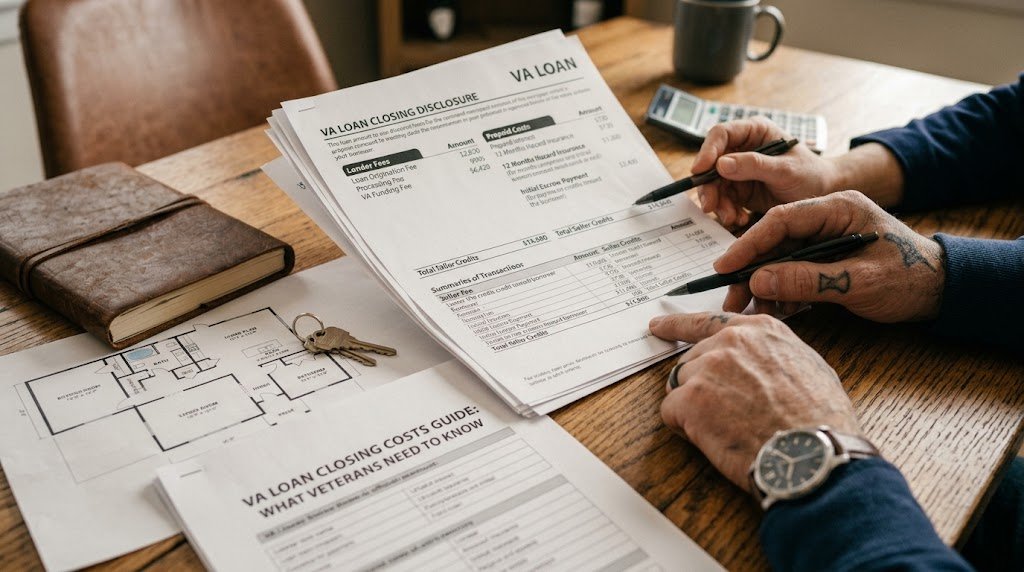
VA Loan Closing Costs Guide: What Veterans Need to Know is essential reading for anyone planning to buy a home with a VA-backed mortgage. A VA loan can offer major advantages, including no required down payment in many situations and no monthly private mortgage insurance, but zero down does not mean zero cash needed to close.
VA closing costs can include the lender\’s origination charge, appraisal, title services, recording fees, prepaid taxes and insurance, discount points, and other transaction expenses. The exact amount depends on the lender, property, location, loan amount, and the borrower\’s circumstances. The VA says borrowers should review the Loan Estimate and Closing Disclosure carefully because lenders determine many of the costs.
The good news is that VA rules can protect eligible borrowers from certain charges, and sellers can potentially pay some or all standard closing costs. Understanding the difference between closing costs, the VA funding fee, seller concessions, and cash-to-close can make the homebuying process much easier.

What Are VA Loan Closing Costs?
VA loan closing costs are the fees and prepaid expenses associated with completing a mortgage and transferring a property to the buyer.
They generally fall into several categories:
- Lender charges — origination fees, underwriting-related charges, and discount points.
- Third-party services — appraisal, credit report, title work, survey, and other services.
- Government charges — recording fees and certain state or local taxes.
- Prepaid expenses — homeowners insurance, property taxes, and prepaid interest.
- VA-specific costs — primarily the VA funding fee, when applicable.
One important distinction is that closing costs are not the same as a down payment. A qualified borrower may purchase a home with no down payment while still needing money for eligible closing expenses.
The VA specifically states that, for a purchase or construction/permanent loan, the VA funding fee can be financed, but other closing costs generally cannot simply be added to the loan balance.
VA Loan Guide: How to Buy a Home With $0 Down Payment
How Much Are VA Loan Closing Costs?
There is no universal dollar amount.
Some mortgage lenders and industry guides use a broad estimate of approximately 2%–5% of the loan amount, while Veterans United currently describes a typical range of 3%–5%. These are planning estimates rather than VA-mandated charges. Your actual costs can be substantially different depending on the transaction.
For illustration, consider a hypothetical $350,000 VA purchase:
| Estimated percentage | Approximate costs |
|---|---|
| 2% | $7,000 |
| 3% | $10,500 |
| 4% | $14,000 |
| 5% | $17,500 |
These figures are examples, not a quote. They can include different combinations of lender fees, title charges, prepaid expenses, and other costs.
Why costs vary
Your final amount can depend on:
- Loan amount
- Property location
- Lender fees
- Appraisal charges
- Title insurance and settlement services
- Discount points
- Homeowners insurance
- Property taxes
- Whether you qualify for a funding-fee exemption
- Seller credits or other negotiated contributions
The VA emphasizes that lenders—not the VA—set the interest rate, discount points, and most closing costs. Comparing lenders can therefore make a meaningful difference.
VA Loan Closing Costs: What Fees Will You Actually Pay?
Understanding individual charges is more useful than relying on a single percentage.
VA funding fee
The VA funding fee is a one-time charge that helps support the VA home loan program.
For purchase and construction loans, current VA rates for Veterans, active-duty service members, and National Guard and Reserve members are:
| Down payment | First use | Subsequent use |
|---|---|---|
| Less than 5% | 2.15% | 3.30% |
| 5% or more | 1.50% | 1.50% |
| 10% or more | 1.25% | 1.25% |
These percentages apply to the loan amount, not simply the home\’s purchase price.
For example, if a first-time VA buyer borrows $300,000 with less than 5% down, a 2.15% funding fee would be $6,450.
The fee can generally be paid at closing or financed into the loan. Financing it reduces the cash required upfront, but it also increases the amount borrowed and therefore can increase interest paid over time.
Who is exempt from the funding fee?
Some borrowers don\’t have to pay it.
VA says exemptions can apply to borrowers who receive or are eligible to receive VA compensation for a service-connected disability, certain surviving spouses receiving Dependency and Indemnity Compensation, qualifying active-duty Purple Heart recipients, and certain other circumstances.
If you think you qualify for an exemption, confirm your status with the VA and lender before assuming the fee will disappear.
Origination fee
VA rules limit the lender\’s standard origination charge to 1% of the loan amount when the lender uses the flat-fee approach. VA rules also address which additional charges may be passed to the borrower depending on how the lender structures its fees.
This is one reason comparing Loan Estimates is so important.
Appraisal fee
A VA appraisal is required for a VA-backed purchase loan. It helps establish whether the property meets VA requirements and whether the value supports the loan.
The appraisal is different from a home inspection. A borrower may still want a separate inspection to evaluate the physical condition of the property.
Title and recording costs
Depending on the transaction and location, buyers may encounter:
- Title search
- Lender\’s title insurance
- Settlement services
- Recording fees
- Attorney fees where applicable
- Survey-related charges
These are not unique to VA financing, but they can appear on a VA closing statement.
Prepaid taxes and insurance
Your cash-to-close calculation may also include prepaid items such as:
- Homeowners insurance
- Property taxes
- Prepaid interest
- Initial escrow deposits
These aren\’t necessarily lender \”fees.\” They are amounts collected at closing to cover future housing expenses.

Can the Seller Pay VA Loan Closing Costs?
Yes. Seller contributions can be an important part of negotiating a VA purchase.
The VA allows sellers or builders to offer credits toward certain buyer closing costs. Importantly, the rules distinguish between standard closing costs and seller concessions.
This distinction is frequently misunderstood.
Standard closing costs
The seller can potentially pay some or all of the buyer\’s allowable closing costs, subject to the transaction and contract.
Examples can include certain:
- Lender charges
- Appraisal fees
- Title expenses
- Recording fees
- Prepaid expenses
The 4% seller concession rule
The VA limits seller concessions to 4% of the home\’s reasonable value.
But that does not mean a seller can only contribute 4% toward every possible closing expense.
The VA itself explains that the 4% limit applies to specific concessions, while certain ordinary closing costs can be paid by the seller without being treated the same way under that cap.
That distinction can make a substantial difference when negotiating a purchase contract.
VA Loan Seller Concessions Explained
What VA Closing Costs Can the Buyer Not Pay?
One of the advantages of the VA program is that borrowers have protections against certain charges.
VA rules contain a list of fees and charges that may be considered non-allowable for the Veteran to pay under particular circumstances.
For example, when the lender charges the standard 1% origination fee, certain additional lender-related expenses may not be charged separately to the Veteran. The exact treatment can depend on the lender\’s fee structure.
This is another reason not to compare mortgages using only the advertised interest rate.
Instead, compare:
- Interest rate
- APR
- Origination charges
- Discount points
- Lender credits
- Appraisal costs
- Title costs
- Estimated cash to close
If a fee appears on your Loan Estimate and you don\’t understand it, ask the lender to explain exactly what service it covers.
Can You Roll VA Loan Closing Costs Into the Mortgage?
For a VA purchase loan, the answer is generally no—not for ordinary closing costs.
The VA allows the funding fee to be financed. Other purchase-loan closing costs generally must be paid through cash, seller contributions, lender credits, or other permitted sources.
This is a crucial point for anyone planning a \”$0 down\” purchase.
A $0 down payment does not mean you should arrive at closing with $0 available.
What about refinancing?
Rules can differ for certain VA refinance transactions.
For example, the VA explains that certain allowable costs can be included in an Interest Rate Reduction Refinance Loan (IRRRL), subject to program requirements.
So don\’t automatically apply purchase-loan rules to a refinance.
How Can Veterans Reduce VA Loan Closing Costs?
There are several legitimate ways to lower upfront expenses.
1. Compare multiple lenders
The VA does not set most lender-specific rates and charges.
Request Loan Estimates from multiple lenders and compare the actual numbers rather than choosing based only on a headline interest rate. VA specifically recommends shopping around because lenders can offer different rates and fees.
2. Negotiate seller-paid costs
A seller credit can reduce the amount of cash you need to bring to closing.
Your real estate professional can help determine what request makes sense for the local market and your purchase offer.
3. Consider lender credits carefully
A lender may offer credits toward closing costs in exchange for a higher interest rate.
This can reduce upfront cash but potentially increase your monthly payment and long-term interest expense.
4. Review discount points
Paying points can reduce your interest rate, but it requires more cash upfront.
The right choice depends on how long you expect to keep the mortgage and the difference between the rate options.
5. Check your funding-fee status
If you\’re eligible for a funding-fee exemption, confirming that before closing can eliminate one of the largest VA-specific charges.
6. Read every disclosure
Don\’t wait until the closing table to discover an unexpected fee.
Loan Estimate vs. Closing Disclosure: What Veterans Should Check
Two documents are particularly important.
Loan Estimate
Your lender generally provides a Loan Estimate early in the mortgage process after receiving the required application information.
It gives you an estimate of:
- Loan amount
- Interest rate
- Monthly payment
- Origination charges
- Appraisal and other services
- Prepaid expenses
- Estimated cash to close
Closing Disclosure
The Closing Disclosure provides the final details of your mortgage transaction.
VA notes that the lender must provide it at least three business days before closing, giving you time to review the terms, fees, closing costs, and estimated payments.
Mortgage Closing Disclosure Checklist
A practical comparison method
Put your Loan Estimate and Closing Disclosure side by side.
Look for changes in:
- Interest rate
- Loan amount
- Origination fee
- Discount points
- Appraisal
- Title services
- Taxes
- Insurance
- Seller credits
- Cash to close
A changed number isn\’t automatically an error. Some costs can legitimately change during a transaction. But an unexplained increase deserves a question before you sign.
A Realistic VA Closing Cost Example
Consider a hypothetical Veteran purchasing a $350,000 home with $0 down.
Suppose the buyer has:
- $350,000 loan amount
- 2.15% funding fee
- $7,525 funding fee
- $5,500 in other eligible closing and prepaid costs
The initial funding fee plus other costs would put the estimated transaction expenses at $13,025 before any seller credits or other adjustments.
The Veteran could potentially finance the $7,525 funding fee, while the remaining costs would need to be handled through available funds, seller contributions, lender credits, or another permitted source.
This example demonstrates an important point:
The biggest cash-to-close question isn\’t simply \”Do I need a down payment?\” It\’s \”After seller credits, lender credits, financing options, and prepaid expenses, how much cash will actually be required at closing?\”
That is the number worth planning around.
What About the New 2026 Tax Treatment of the Funding Fee?
There is also a notable 2026 development for eligible taxpayers.
The VA reported in February 2026 that Veterans, service members, and surviving spouses can deduct qualifying VA funding fees on their taxes for homes purchased using the VA-guaranteed home loan program. The VA says the change applies starting in 2026.
Tax treatment depends on individual circumstances, so this should not be interpreted as a guarantee that every borrower will receive a specific tax benefit.
If this potentially applies to you, discuss the deduction with a qualified tax professional.
VA Loan Closing Costs vs. Other Mortgage Costs
A VA loan doesn\’t eliminate every expense associated with buying a home.
However, it has several features that can reduce the financial burden compared with some alternatives:
- No required down payment in qualifying circumstances
- No monthly PMI
- VA rules limiting certain borrower-paid charges
- Potential seller-paid closing costs
- Funding fee that can generally be financed on a purchase loan
The trade-off is that eligible borrowers may have to pay the VA funding fee unless exempt.
The best mortgage isn\’t determined by one fee. Compare the total cost of borrowing, cash required at closing, monthly payment, and how long you expect to keep the loan.
VA Loan vs Conventional Loan Complete Comparison Guide
Final Thoughts: How to Prepare for VA Loan Closing Costs
A VA loan can dramatically reduce the upfront barrier to homeownership, but smart planning means budgeting beyond the down payment.
Before closing, make sure you:
- Understand your VA funding-fee status.
- Compare Loan Estimates from multiple lenders.
- Ask about lender credits and discount points.
- Negotiate seller-paid closing costs when appropriate.
- Understand the difference between closing costs and seller concessions.
- Review your Closing Disclosure at least three business days before closing.
- Confirm exactly how much cash you need to bring.
The strongest strategy is simple: don\’t focus only on getting to the closing table with the least cash possible. Focus on getting there with a mortgage whose total cost makes sense for your long-term budget.
For official program rules, always verify the latest information directly with the U.S. Department of Veterans Affairs.
3. FAQ Section
1. How much are closing costs on a VA loan?
VA loan closing costs vary by lender, property, location, loan amount, and borrower circumstances. Industry estimates commonly fall around 2%–5% of the loan amount, but your Loan Estimate provides a more useful personalized estimate.
2. Can the seller pay VA loan closing costs?
Yes. Sellers or builders can potentially pay some or all of a buyer\’s allowable closing costs. VA rules also allow seller concessions, which are subject to a separate 4% limit.
3. Can VA closing costs be rolled into the loan?
For a VA purchase loan, the VA funding fee can be financed. Ordinary purchase closing costs generally cannot simply be added to the loan amount. Certain refinance transactions have different rules.
4. Do all Veterans have to pay the VA funding fee?
No. Certain Veterans, service members, and surviving spouses can qualify for a funding-fee exemption, including qualifying borrowers receiving or eligible for VA compensation for a service-connected disability.
5. What is the VA funding fee in 2026?
For VA purchase and construction loans, the current funding fee for many Veterans and service members is 2.15% for first use with less than 5% down and 3.3% for subsequent use with less than 5% down. Lower percentages apply with larger down payments.
6. When will I know my final VA closing costs?
Your Loan Estimate provides an early estimate, while your Closing Disclosure provides the final loan terms and closing-cost details. The Closing Disclosure must generally be provided at least three business days before closing.