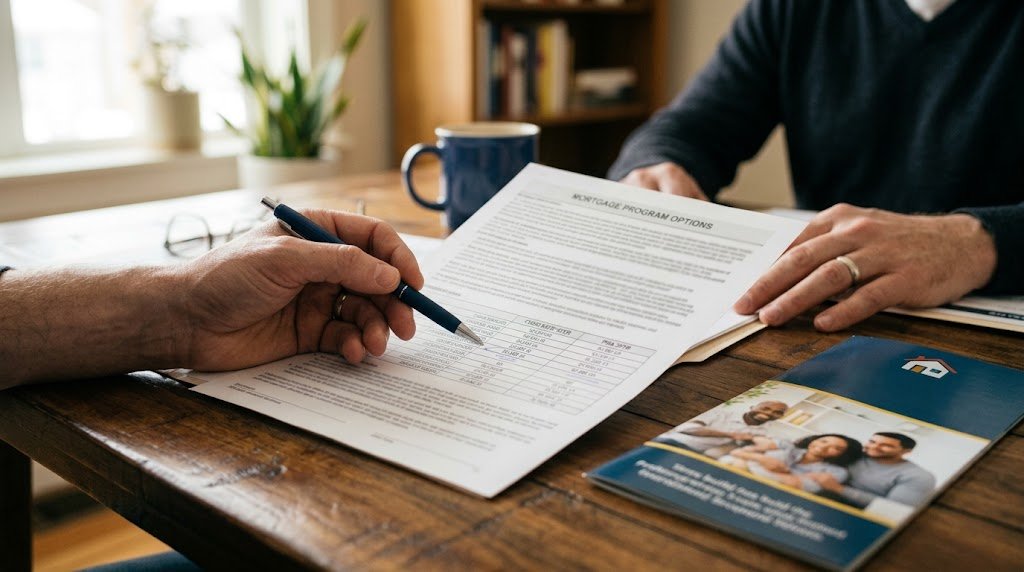
First-Time Home Buyer Mortgage Guide: Programs & Requirements can help you understand what lenders look for, which mortgage programs may fit your finances, and how much cash you may actually need to buy a home in the United States.
Buying your first home can feel complicated because there is no single “first-time buyer mortgage.” Instead, buyers may qualify for conventional loans, FHA loans, VA loans, USDA financing, specialized conventional programs, and state or local down payment assistance.
The short answer: first-time buyers should compare loan eligibility, total cash needed, monthly payment, mortgage insurance, interest rate, and assistance programs—not simply choose the loan with the lowest down payment.
This guide focuses specifically on U.S. homebuyers and explains the major requirements and programs to investigate in 2026.

First-Time Home Buyer Mortgage Guide: Who Qualifies?
A common misconception is that a first-time buyer must have never owned a home before. That is not always true.
For many major mortgage and assistance programs, a first-time homebuyer is generally someone who has not owned an interest in a principal residence during the previous three years. Specific programs can have their own definitions and exceptions. Fannie Mae, for example, uses a three-year ownership test in its first-time homebuyer definition.
This means you may potentially qualify as a first-time buyer if:
- You have never owned a home.
- You previously owned a home but have not owned one for at least three years.
- You are a single parent or displaced homemaker who meets applicable program rules.
- You are purchasing your first principal residence after a period of renting.
However, first-time buyer status does not automatically guarantee mortgage approval. Your lender will still review income, employment, credit history, debts, assets, property type, and ability to repay.
What Is a Mortgage Pre-Approval?
What Mortgage Programs Are Available to First-Time Buyers?
The best mortgage depends on your financial profile, property location, military eligibility, income, credit history, and available cash.
Conventional Mortgages
Conventional mortgages are offered by private lenders and are not insured by the federal government.
Some conventional programs allow down payments as low as 3% for qualified borrowers. Fannie Mae\’s HomeReady mortgage, for example, offers down payments as low as 3% and allows eligible buyers to use multiple sources for down payment and closing costs.
Freddie Mac\’s Home Possible program also offers a down payment as low as 3%, flexible funding sources, and reduced mortgage insurance for eligible borrowers.
Best for: Buyers with reasonably strong credit, stable income, and a desire to use a low-down-payment conventional option.
FHA Loans
FHA loans are insured by the Federal Housing Administration and are widely used by first-time buyers.
HUD states that FHA financing can offer a down payment as low as 3.5% and is available for eligible 1–4 unit properties.
FHA can be particularly useful for buyers who may not qualify for some conventional options. However, FHA loans include mortgage insurance costs, so the smallest down payment is not necessarily the cheapest overall option.
Best for: Buyers who need flexible credit and down-payment requirements and who meet FHA underwriting standards.
VA Loans
Eligible veterans, active-duty service members, and certain surviving spouses may qualify for VA-backed financing.
A VA-backed purchase loan can allow no down payment when the buyer and property meet applicable requirements. VA loans also generally do not require monthly private mortgage insurance. A VA funding fee may apply unless the borrower qualifies for an exemption.
Best for: Eligible military borrowers who want to preserve cash and take advantage of VA benefits.
USDA Loans
USDA Rural Development loans can be an important option for buyers purchasing eligible homes in qualifying rural areas.
The USDA Guaranteed Loan Program can provide 100% financing, meaning qualified buyers may purchase with no down payment. Income and property-location requirements apply.
Best for: Buyers with qualifying income who are purchasing a home in an eligible rural area.
State and Local First-Time Buyer Programs
Federal mortgage programs are only part of the picture.
State housing finance agencies, cities, counties, nonprofit organizations, employers, and other organizations may offer:
- Down payment assistance
- Closing-cost assistance
- Forgivable loans
- Deferred-payment loans
- Grants
- Mortgage credit programs
- Homebuyer education
- Special affordable mortgage products
Eligibility can depend on income, purchase price, location, household size, occupation, and first-time buyer status.

A useful starting point is your state\’s housing finance agency and a HUD-approved housing counselor. HUD maintains a directory of approved housing counseling agencies that can help buyers understand budgets, credit, financing, and homeownership barriers.
What Are the Mortgage Requirements for First-Time Buyers?
There is no universal credit score, income, or debt-to-income requirement for every mortgage. Each loan program and lender can have different rules.
Still, lenders commonly examine five major areas.
1. Credit History
Your credit profile helps the lender evaluate how you have handled debt.
A stronger credit profile can potentially improve your mortgage options and pricing, but a lower score does not automatically mean homeownership is impossible. FHA and certain specialized conventional programs may provide alternatives.
Do not focus only on the score you see in a consumer credit app. Mortgage lenders may use different scoring models and underwriting standards.
2. Income and Employment
Lenders generally need to verify your income and determine whether it is sufficient and stable enough to support the proposed mortgage payment.
You may need documentation such as:
- Pay stubs
- W-2 forms
- Tax returns
- Bank statements
- Employment information
- Documentation of additional income
Self-employed buyers may face additional documentation requirements because lenders need to evaluate business and personal income.
3. Debt-to-Income Ratio
Your debt-to-income ratio, or DTI, compares your monthly debt obligations with your qualifying gross monthly income.
For example, if qualifying income is $8,000 per month and qualifying monthly debts are $3,200, the DTI is 40%.
A lower DTI can make your application easier to manage, but acceptable ratios vary by loan program and lender.
4. Down Payment and Available Assets
You do not necessarily need 20% down to buy a home.
The CFPB notes that many buyers can use down payments starting around 3%, depending on the mortgage and lender. It also emphasizes that buyers should keep money available for moving expenses and other costs rather than putting every dollar into the down payment.
5. Property and Occupancy
The lender also evaluates the property.
The home may need to satisfy requirements involving:
- Appraised value
- Property condition
- Occupancy
- Property type
- Insurance
- Loan-program guidelines
A buyer can have excellent finances and still encounter problems if the property does not meet the selected loan\’s requirements.
Mortgage Requirements Checklist for Home Buyers
How Much Money Do First-Time Buyers Really Need?
One of the biggest mistakes first-time buyers make is calculating only the down payment.
Your total cash requirement can include:
- Down payment
- Lender fees
- Appraisal
- Title-related costs
- Prepaid taxes and insurance
- Escrow funding
- Inspection
- Moving expenses
- Initial repairs or maintenance
- Homeowners association fees, if applicable
Your Loan Estimate is one of the most important documents to review because it provides estimated loan terms and costs. The CFPB says lenders generally must provide a Loan Estimate within three business days after receiving the required application information.
A Simple 2026 Example
Suppose you purchase a $350,000 home with a 3% down payment.
- Purchase price: $350,000
- 3% down payment: $10,500
- Remaining loan amount before other adjustments: approximately $339,500
Now imagine your closing costs, prepaid expenses, and other required cash items total another hypothetical $14,000.
Your initial cash requirement could therefore be around $24,500, before considering reserves, moving expenses, or repairs.
This illustrates an important point: a 3% down payment does not mean you only need 3% of the purchase price in cash.
How Does the First-Time Home Buying Process Work?
A practical sequence looks like this:
Step 1: Review Your Finances
Check your credit, income, debts, savings, and recurring expenses.
Create a realistic monthly housing budget rather than starting with the maximum amount a lender says you can borrow.
Step 2: Compare Mortgage Programs
Ask lenders to compare conventional, FHA, VA, USDA, and applicable assistance programs.
Look beyond the advertised interest rate. Compare APR, mortgage insurance, lender fees, cash-to-close, and estimated monthly payment.
Step 3: Get Pre-Approved
A pre-approval gives you a clearer picture of your potential purchasing power.
It can also make your offer more credible to sellers.
Step 4: Search for the Right Property
Once you understand your budget, begin shopping for homes that fit both your financial limits and lifestyle needs.
Do not forget taxes, insurance, HOA dues, utilities, and maintenance.
Step 5: Make an Offer
Your real estate professional can help structure the offer, including contingencies and seller concessions where appropriate.
Step 6: Complete Inspection and Appraisal
An inspection helps identify potential property problems.
The appraisal is different: it helps the lender evaluate whether the property\’s value supports the mortgage.
Step 7: Review Your Closing Disclosure
Before closing, carefully review your final loan terms and costs.
Federal mortgage rules generally require the Closing Disclosure at least three business days before closing for covered transactions.
Compare it with your earlier Loan Estimate and ask about unexpected changes.
Mortgage Closing Process Explained
How Can First-Time Buyers Save Money?
The cheapest mortgage is not always the one with the lowest advertised rate.
Before choosing a loan, compare:
- Interest rate
- APR
- Mortgage insurance
- Upfront lender fees
- Closing costs
- Required cash to close
- Monthly payment
- Ability to refinance or cancel mortgage insurance when applicable
- Down payment assistance
- Total estimated cost over your expected ownership period
Also consider whether keeping some savings after closing is more valuable than making a larger down payment.
For example, putting an extra $10,000 into the house may reduce your loan balance, but using every available dollar could leave you without an emergency fund for repairs, moving costs, or unexpected expenses.
Common First-Time Home Buyer Mistakes to Avoid
Mistake 1: Assuming You Need 20% Down
Many qualifying mortgage programs allow substantially less than 20%. Freddie Mac notes that down payments can be as low as 3% for certain products.
Mistake 2: Shopping for a House Before Checking Affordability
Know your comfortable monthly payment first.
Mistake 3: Comparing Only Interest Rates
A lower rate with high fees may not be the best deal.
Mistake 4: Spending Every Dollar at Closing
Maintain an emergency reserve whenever your overall financial situation allows.
Mistake 5: Ignoring Assistance Programs
State and local assistance can significantly change the amount of cash you need upfront.
Mistake 6: Making Major Financial Changes Before Closing
Avoid unnecessary new debt, large unexplained deposits, or major changes in employment without discussing them with your lender.
Frequently Asked Questions About First-Time Home Buyer Mortgages
Do first-time home buyers need 20% down?
No. Some eligible mortgage programs allow down payments as low as 3%, while FHA can allow 3.5%, and qualifying VA and USDA borrowers may be able to purchase with no down payment.
What credit score do I need to buy my first home?
There is no single minimum score for every mortgage. FHA, conventional, VA, USDA, and individual lender requirements can differ. Your credit score is only one part of the underwriting decision.
Can I get down payment assistance?
Possibly. Assistance may be available through state and local housing agencies, nonprofits, employers, and other programs. Eligibility rules vary by location and program.
Is FHA better than a conventional mortgage for first-time buyers?
Not automatically. FHA may be attractive for certain borrowers with limited cash or more flexible credit needs, while conventional programs may offer advantages such as cancellable mortgage insurance under applicable rules. Compare the total cost rather than choosing based solely on the down payment.
Can a previous homeowner qualify as a first-time buyer?
Potentially. Many programs use a three-year lookback period, meaning someone who has not owned a principal residence for the previous three years may qualify under the program\’s definition. Always verify the specific program rules.
Conclusion: Choose the Mortgage That Fits Your Financial Life
Your first home purchase should start with a financing strategy—not simply a house listing.
A strong First-Time Home Buyer Mortgage Guide should help you compare the complete picture: credit, income, debt, down payment, assistance programs, mortgage insurance, closing costs, monthly payment, and long-term affordability.
In 2026, first-time buyers have more than one path to homeownership. Conventional 3% options, FHA financing, VA benefits, USDA rural financing, and state or local assistance can all be worth investigating depending on your circumstances.
Before applying, compare multiple lenders, ask for a written breakdown of costs, and verify current program requirements.
Ready to explore your options?
First-Time Home Buyer Mortgage Options
Use this guide as your starting point, then speak with a qualified mortgage professional or HUD-approved housing counselor about your specific situation.
3. FAQ Section
1. What is the best mortgage for a first-time home buyer?
There is no single best mortgage for everyone. Conventional, FHA, VA, USDA, and specialized first-time buyer programs can each be appropriate depending on credit, income, location, military eligibility, down payment, and total loan cost.
2. What is the minimum down payment for a first-time home buyer?
Some conventional programs allow 3% down, FHA can allow 3.5%, and eligible VA and USDA borrowers may qualify for 0% down financing. Program and lender requirements apply.
3. How much money should I save before buying a house?
Save for more than the down payment. Plan for closing costs, prepaid taxes and insurance, inspections, moving expenses, immediate repairs, and an emergency reserve.
4. Can I buy a house with bad credit?
Possibly. Some mortgage programs are designed to accommodate borrowers with less-than-perfect credit, but approval depends on the complete financial profile, loan program, lender requirements, and property.
5. Should first-time buyers get pre-approved?
Yes. A pre-approval can help you understand your potential borrowing range and demonstrate to sellers that you have taken steps toward financing.
6. Where can I find first-time home buyer assistance?
Check your state and local housing agencies, nonprofit programs, participating lenders, and HUD-approved housing counselors. Assistance can include grants, deferred loans, forgivable assistance, or other cost-saving programs.