
If you carry student debt and want to buy a home, the first question is rarely about your credit score or your down payment. It is about student loans and your mortgage, and how the two fit together in one number your lender cares about a great deal. That number is your debt-to-income ratio, usually shortened to DTI. Lenders do not count your full student loan balance against you. They count a monthly payment. The tricky part is that the payment they count is not always the payment you actually make, and the rule changes with the loan program you choose.
How Student Loans and Your Mortgage Connect Through DTI
Your debt-to-income ratio compares your monthly debt payments with your gross monthly income, which is your income before taxes and other deductions. The Consumer Financial Protection Bureau explains it plainly: add up all your monthly debt payments, divide by your gross monthly income, and multiply by 100. Debts of $2,000 a month on income of $6,000 a month give a DTI of 33 percent.
Lenders look at two versions of this ratio. The front-end ratio covers only housing costs: principal, interest, taxes and insurance, known as PITI, plus any homeowners association dues. The back-end ratio adds every other recurring monthly debt, including car loans, credit card minimums, personal loans, child support, and student loans. Your student loan balance itself does not go into the ratio. Only a monthly payment figure does.
How Lenders Calculate DTI, Step by Step

Here is a worked example. Suppose you earn $90,000 a year, or $7,500 a month before tax. Your PITI payment would be $2,100, your car payment $350, and your credit card minimums $120. If your lender counts a $250 student loan payment, your total debts are $2,820 and your back-end DTI is 37.6 percent. Counted at $500, your DTI rises to 40.9 percent, and at $600 it reaches 42.3 percent. The same borrower and the same balance can land on either side of a lender’s comfort zone depending only on which payment figure the program requires.
So before you apply, find out which payment your lender will use. Check your credit report, then get a current servicer statement showing your actual payment, your plan, and your next recertification date. Forgiven or paid-off loans do not count, but you will need written confirmation to prove it.
FHA vs Conventional vs VA: What Each Program Counts
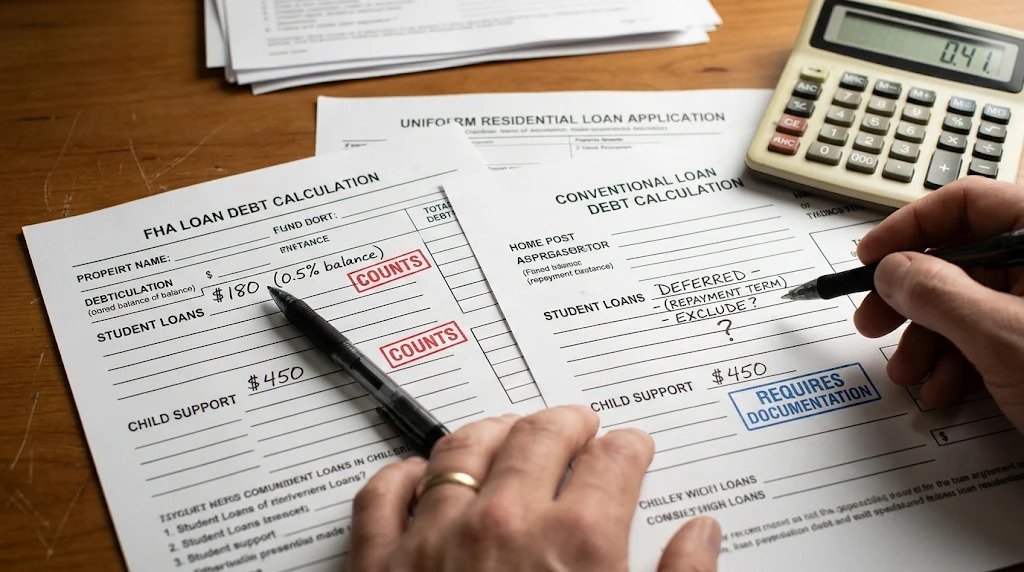
The same student loan can be counted four different ways. The table below uses a $60,000 balance with a $0 payment on the credit report, so you can compare the programs side by side.
| Loan program | Payment counted when the credit report shows $0 |
|---|---|
| FHA | 0.5 percent of the balance, which is $300 a month on $60,000 |
| Fannie Mae conventional | Documented $0 income-driven payment can count as $0; deferred loans count at 1 percent of the balance or a fully amortizing payment |
| Freddie Mac conventional | 0.5 percent of the balance, which is $300 a month on $60,000, never $0 |
| VA | 5 percent of the balance divided by 12, which is $250 a month on $60,000 |
FHA counts your actual payment when it is more than $0, or 0.5 percent of your balance when your credit report shows no payment. That rule comes from a June 2021 change in Mortgagee Letter 2021-13, which replaced an older 1 percent rule, and it still applies as of the November 2025 revision of the HUD handbook. FHA uses a 31 percent front-end and 43 percent back-end DTI guideline, but its automated system, TOTAL Scorecard, can approve files up to 56.99 percent back-end DTI when compensating factors such as strong credit or reserves are present.
Fannie Mae, in Selling Guide B3-6-05 updated in August 2026, is the most forgiving on income-driven plans: a servicer-documented $0 payment can count as $0. But a deferred or forbearance loan counts at 1 percent of the balance or a fully amortizing payment, which is $600 a month on a $60,000 deferred balance.
VA treats 41 percent DTI as a guideline rather than a hard ceiling, and it also weighs residual income, the money left after housing and debts. A VA lender counts the higher of your reported payment or 5 percent of your balance divided by 12, unless a servicer statement dated within 60 days of closing documents a lower payment. The one exception is deferment: with written proof that your loans will stay deferred at least 12 months past closing, the payment is left out entirely.
Income-Driven Repayment Plans and Your Mortgage
An income-driven repayment plan, or IDR, sets your federal student loan payment from your income and family size rather than from your balance. For many borrowers the payment is far lower than the standard ten year payment, and for some it is $0. That lower payment can help your mortgage application, but only if your loan program recognises it. On a Fannie Mae loan a documented $0 IDR payment can count as $0. On FHA and Freddie Mac loans the same $0 payment still counts at 0.5 percent of your balance, and on a VA loan it is generally 5 percent divided by 12. Run the numbers both ways before you choose.
Two changes in 2026 make this urgent. The SAVE plan ended after a court order in March 2026, and servicers began notifying SAVE borrowers from July 1, 2026, to choose a new plan. A new Repayment Assistance Plan, known as RAP, has a $10 minimum monthly payment. If you were on SAVE, check with your servicer now and get your new payment in writing. Also watch your recertification date: a higher income means a higher payment, while recertifying early after an income drop can lower your payment and your DTI.
Deferred Loans and Forbearance: The $0 Payment Trap
The most common misunderstanding here is the idea that a loan you are not paying right now does not count. For mortgage purposes, it almost always does. A deferred loan pauses payments, often while you are still in school or in a grace period. Forbearance is a temporary pause granted by your servicer, often during hardship. FHA and Freddie Mac both count 0.5 percent of the balance, Fannie Mae counts 1 percent or a fully amortizing payment, and VA counts 5 percent divided by 12 unless the loan stays deferred at least 12 months past closing.
This catches out recent graduates in particular. If your loans are in a six month grace period when you close, the lender will count a placeholder payment based on your balance, which may be higher than the payment you will actually owe. Get your servicer to put your expected payment in writing before you apply. Defaulted federal loans block FHA, VA and USDA financing until resolved, so deal with a default first.
How to Lower Your DTI Before You Apply
You cannot change the agency rules, but you can change the numbers that go into them. First, pay off small debts completely. Because DTI uses monthly payments rather than balances, clearing a $200 a month car payment frees up more room than paying down a large balance by a few thousand dollars. Second, choose the program that counts your student loans most favourably. Third, get your IDR payment documented and current, and recertify early if your income has dropped.
Fourth, consider a larger down payment or a less expensive home, which lowers your PITI payment and both ratios at once. Our guide to HomeReady and Home Possible loans explains low down payment options beyond FHA. Fifth, avoid new debts while house hunting, because lenders recheck your credit before closing. Finally, check your credit reports for errors and read our guide to what PITI includes. Before you apply, ask your lender how they will count your student loans, and read our guide to mortgage rate shopping windows before you shop for rates.
Frequently Asked Questions
Do student loans count in my debt-to-income ratio?
Yes. Lenders count a monthly student loan payment in your back-end DTI, not your total balance. Even deferred loans are usually counted, using a placeholder payment based on the balance.
How is DTI calculated for a mortgage?
Add up all monthly debt payments, including housing, car loans, credit card minimums and student loans. Divide by gross monthly income, then multiply by 100 to get a percentage.
What is the FHA student loan DTI rule in 2026?
FHA counts your actual payment when it is above $0, or 0.5 percent of your balance when the credit report shows no payment. On $60,000 that is $300 a month, and deferred loans are not excluded.
Does Fannie Mae count a $0 income-driven payment as $0?
Yes, with documentation. Under Selling Guide B3-6-05, a lender may verify with your servicer that your income-driven payment is $0 and qualify you with a $0 payment. Deferred loans instead count at 1 percent.
How does Freddie Mac count student loans?
Freddie Mac never counts a student loan as $0. Under Guide 5401.2 it uses your documented payment above $0, or 0.5 percent of the balance. A recertification due soon may mean a higher figure is used.
How does a VA loan count student loans?
A VA lender counts the higher of your reported payment or 5 percent of your balance divided by 12, unless a servicer statement dated within 60 days of closing documents a lower payment. Loans deferred 12 months past closing, with proof, are left out.
Do deferred student loans affect my mortgage approval?
Yes, almost always. Deferment pauses your payments but not the DTI calculation. FHA and Freddie Mac count 0.5 percent of the balance, Fannie Mae counts 1 percent, and VA counts 5 percent divided by 12.
Can an income-driven repayment plan help me qualify?
It can, especially on a Fannie Mae loan, where a documented low or $0 payment is counted as it stands. On FHA and Freddie Mac loans the benefit is smaller, because a $0 payment still counts at 0.5 percent of the balance.
What DTI do I need to buy a house with student loans?
There is no single number. FHA uses 31 percent front-end and 43 percent back-end guidelines, with approvals possible up to 56.99 percent back-end. Fannie Mae allows up to 50 percent, and VA treats 41 percent as a guideline.
Should I pay off my student loans before buying a home?
Not necessarily. Paying off a small debt completely usually helps DTI more than paying down a large student loan balance, because DTI uses monthly payments. Keeping a low IDR payment may be the better move.
What happened to the SAVE repayment plan in 2026?
SAVE ended after a court order in March 2026. Servicers began notifying borrowers from July 1, 2026, to choose a new plan. The new Repayment Assistance Plan, or RAP, has a $10 minimum monthly payment.
Can I get a mortgage if my student loans are in default?
A defaulted federal student loan blocks FHA, VA and USDA financing until you resolve it, usually through rehabilitation or consolidation. Private loan defaults also damage your credit, so resolve any default first.
#mortgageguiderhub #studentloans #debttoincomeratio #mortgageapproval #FHAloan #homebuying