If you have ever looked at a mortgage statement and wondered why your balance barely moves in the first years, mortgage amortization is the answer. It is the system that splits every monthly payment between interest and principal, and it explains why your payment stays the same while the mix inside it changes month after month. Once you understand it, you can read your loan statement with confidence, compare loan offers properly, and see exactly how extra payments save you money.
What Is Mortgage Amortization?
Amortization is the process of paying off a loan through regular, equal payments over a set period. Each payment covers the interest that has built up since the last payment, and whatever is left over reduces the amount you owe. By the final payment, the balance reaches zero and the loan is fully paid off.
Most home loans in the United States are fully amortizing loans. That means the payment amount is calculated so that, if you pay on time every month for the full term, you will owe nothing at the end. The Consumer Financial Protection Bureau notes that some home loans do not fully amortize, leaving a balance or a large lump sum due at the end, so it is worth confirming that yours does before you sign.
The word sounds technical, but the idea is simple. You borrow a lump sum, the lender charges interest on whatever you still owe, and your fixed monthly payment chips away at the debt a little at a time. The schedule that maps out every payment is called an amortization schedule.
How Mortgage Amortization Works
Here is the part that surprises most first time buyers. With a fixed rate mortgage, your monthly payment for principal and interest never changes. What changes is what is inside that payment. In the early years, most of your payment goes to interest, because your balance is at its highest and interest is charged on the full amount you owe. Only a small slice goes to principal.
As the months pass, each principal payment lowers your balance a little. A lower balance means a slightly smaller interest charge the next month, which means a slightly larger slice of the same fixed payment goes to principal. By the later years of a 30 year loan, the split has flipped, and most of each payment is reducing your balance.
The Formula Behind Your Monthly Payment
Lenders calculate your fixed monthly payment with a standard formula. You do not need to memorize it, but seeing it once makes the whole system click:
M = P x [r(1 + r)^n] / [(1 + r)^n – 1]
In this formula, M is your monthly payment for principal and interest, P is the loan amount, r is your monthly interest rate (your annual rate divided by 12), and n is the total number of monthly payments. For a 30 year loan, n is 360. For a 15 year loan, n is 180.
Three inputs decide everything: how much you borrow, your interest rate, and your loan term. A higher rate or a longer term stretches out the interest you pay, while a larger down payment shrinks the loan amount and lowers the payment from day one.
Worked Example: A $300,000 Loan at 6% for 30 Years
Let us make this concrete. Suppose you buy a home and take out a $300,000 mortgage at a fixed 6% annual interest rate for 30 years. Using the formula above, your monthly payment for principal and interest comes to $1,798.65. That number stays the same for all 360 payments, as long as your rate is fixed.
Now look at how the first few payments break down. Your monthly interest rate is 6% divided by 12, which is 0.5% per month. Each month, the interest charge is your current balance times 0.5%.
| Payment | Interest | Principal | Remaining balance |
|---|---|---|---|
| Month 1 | $1,500.00 | $298.65 | $299,701.35 |
| Month 2 | $1,498.51 | $300.14 | $299,401.21 |
| Month 3 | $1,497.01 | $301.65 | $299,099.56 |
| Month 12 | $1,483.16 | $315.49 | $296,315.96 |
Notice what happens in month one. Of your $1,798.65 payment, $1,500 is interest and only $298.65 reduces what you owe. That is more than 83% of the payment going to interest. By month 12, the principal portion has grown to $315.49, but the change is still small. After a full year of payments totaling $21,583.80, you have paid $17,899.78 in interest and reduced your balance by only $3,684.04.
That slow start is normal, and it is the single biggest surprise for new homeowners. You are not doing anything wrong. The math simply front loads the interest because your balance is largest at the beginning.
How Your Payment Changes Over Time
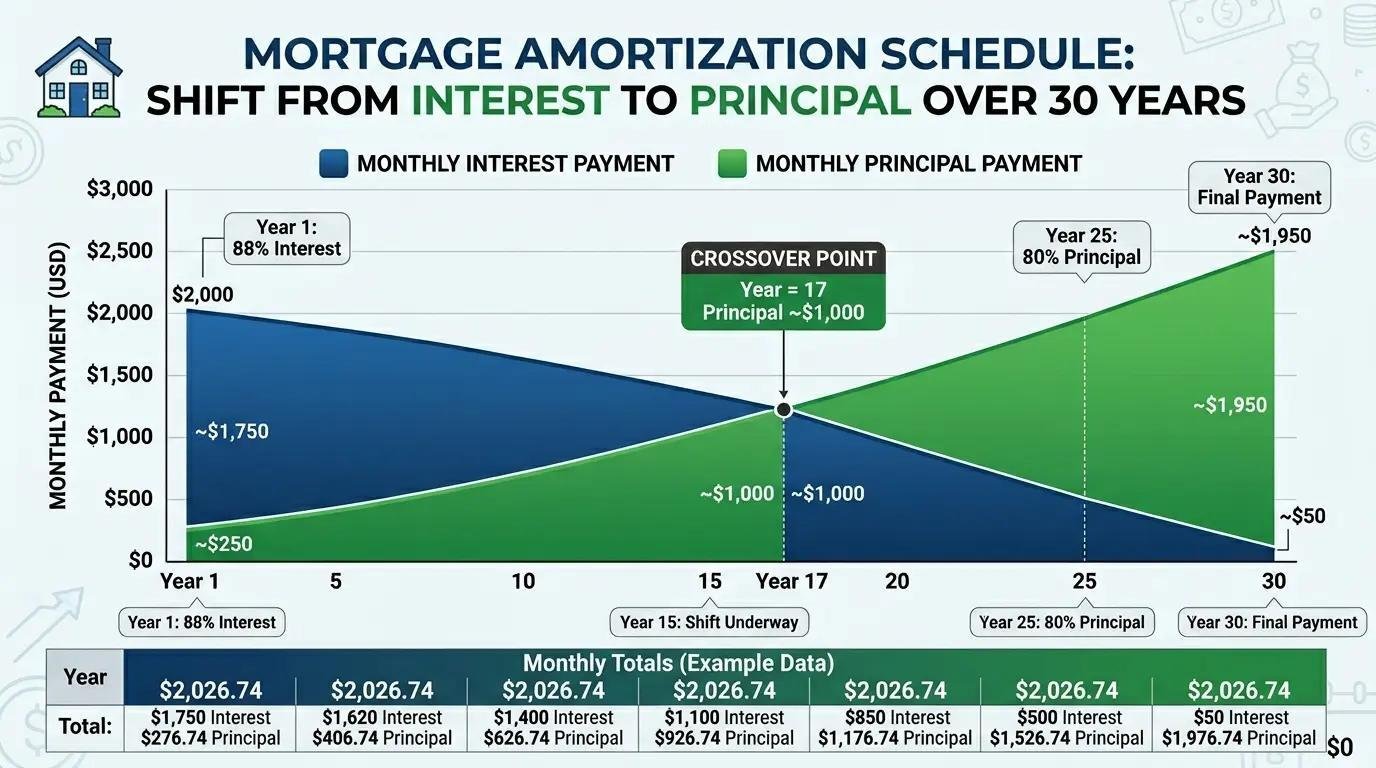
The year by year picture shows the shift clearly. The total amount you pay each year never changes, but the balance falls faster and faster as the years go by.
| Year | Principal paid | Interest paid | Balance at year end |
|---|---|---|---|
| Year 1 | $3,684.04 | $17,899.78 | $296,315.96 |
| Year 5 | $4,680.53 | $16,903.29 | $279,163.07 |
| Year 10 | $6,313.33 | $15,270.49 | $251,057.17 |
| Year 15 | $8,515.74 | $13,068.08 | $213,146.53 |
| Year 20 | $11,486.45 | $10,097.37 | $162,010.76 |
| Year 25 | $15,493.50 | $6,090.32 | $93,036.26 |
| Year 30 | $20,898.41 | $685.41 | $0.00 |
A few milestones stand out. After five years, you still owe $279,163.07, more than 93% of what you borrowed, even though you have paid over $107,000 in total. The crossover point, where the principal portion of a single monthly payment finally passes the interest portion, does not arrive until month 223, which is in year 19 of the loan.
By the final year, the picture has flipped completely. In year 30 you pay only $685.41 in interest and $20,898.41 goes to principal. Over the full 30 years, you will pay $347,514.57 in interest on top of the $300,000 you borrowed, for total payments of $647,514.57. That total is the real cost of borrowing for three decades, and it is why the interest rate you lock in matters so much.
Fixed Rate vs Adjustable Rate Amortization
Everything above assumes a fixed rate mortgage, where the rate and the payment stay constant. With an adjustable rate mortgage, or ARM, the amortization works the same way in principle, but the numbers move. When your rate adjusts, your lender recalculates your payment based on the new rate and the remaining balance and term. Your payment can rise or fall at each adjustment, and the split between interest and principal shifts with it.
Most ARMs start with a fixed rate for a set period, such as five, seven, or 10 years, and then adjust once a year. During the fixed period, the schedule behaves exactly like a fixed rate loan. After that, each adjustment rewrites the remaining schedule, so ask the lender to show you the worst case payment at the rate cap before you commit.
Why Your First Years Build Equity So Slowly
Home equity is the difference between what your home is worth and what you still owe. Because amortization pays down the balance slowly at first, most of your early equity comes from your down payment and from any rise in your home value, not from your monthly payments. After five years on our example loan, your payments have only reduced the balance by about $20,837.
This matters when life changes. If you sell after only a few years, you may walk away with less equity than you expect. It also matters for refinancing, since lenders look at your loan to value ratio, and a slowly falling balance means it takes time before you have enough equity to refinance on better terms or to drop private mortgage insurance.
How Extra Payments Change the Schedule
Extra payments are the most powerful tool a borrower has, because every extra dollar goes straight to principal, and every dollar of principal you remove early stops generating interest for the rest of the loan.
There are a few simple ways to do it:
- Pay a little extra every month. Even $100 extra a month on our example loan shortens the term by several years and saves tens of thousands in interest.
- Make one extra payment a year. Splitting your monthly payment in half and paying every two weeks results in 26 half payments a year, which equals 13 full monthly payments instead of 12. Our guide on biweekly mortgage payments explains how this works and whether it is worth it for you.
- Put windfalls toward principal. A tax refund, a work bonus, or a gift can make a real dent if you apply it directly to the loan balance.
Before you send extra money, check two things with your servicer. First, confirm there is no prepayment penalty on your loan, which is rare on modern mortgages but still worth verifying. Second, make sure the extra money is applied to principal, not treated as an early payment of next month’s bill. A note on the payment or a quick call usually sorts this out.
Extra payments also pair well with a recast. If you make a large lump sum payment toward principal, your lender may agree to recalculate your monthly payment based on the lower balance. Our article on what a mortgage recast is and when it makes sense covers that option in detail.
Amortization and Your Home Equity
As amortization reduces your balance, your equity grows with every payment, even if your home value never changes. Once you have enough equity, new options open up: you can refinance to a lower rate, remove private mortgage insurance once your loan to value ratio falls to 80% or below, or borrow against the equity through a home equity loan or line of credit.
Shorter loan terms build equity far faster. On the same $300,000 loan at 6%, a 15 year term raises the monthly payment to $2,531.57, but the total interest drops to $155,682.69, less than half of the $347,514.57 you would pay over 30 years. The trade off is a payment that is about $733 higher each month, which is a serious budget commitment.
How to Read Your Own Amortization Schedule
Your lender or servicer can provide a full amortization schedule showing all 360 payments, and many servicer websites let you view it online. When you look at it, check your payment number and date, the interest and principal split for your current payment, your remaining balance, and your total interest to date, which is useful at tax time and for judging whether refinancing would save you money.
If the schedule does not match your monthly statement, call your servicer and ask why. A mismatch can happen after a rate adjustment, an escrow change, or a misapplied extra payment, and it is much easier to fix early.
Common Mistakes to Avoid
A few misunderstandings trip up new homeowners again and again. First, many people assume their principal and interest payment is their whole mortgage payment, but most monthly bills also include property taxes and homeowners insurance held in escrow.
Second, some buyers focus only on the monthly payment when comparing loans and ignore the total interest. A slightly lower payment on a longer term can cost far more over the life of the loan. Always compare the total interest and the loan term, not just the monthly figure.
Third, some homeowners assume their payment can never change on a fixed rate loan. The principal and interest part is fixed, but the escrow portion for taxes and insurance can rise or fall each year as those bills change. The Consumer Financial Protection Bureau notes that your escrow payment can change when your home value rises and property taxes go up, even though your principal and interest stay the same. Bankrate’s breakdown of PITI explains the same split in detail.
Finally, do not assume that making extra payments automatically helps. If your servicer applies the extra money to future interest instead of principal, you gain nothing, so always confirm in writing how extra payments are applied.
Amortization is not a trick the lender plays on you. It is simply the math of spreading a large debt over many years. Once you see the schedule, you can plan around it, whether that means choosing a shorter term, adding a small extra payment each month, or timing a refinance for the point when your equity has grown enough to get you a better deal.
Frequently Asked Questions
What is mortgage amortization in simple terms?
Mortgage amortization is the process of paying off your home loan through fixed monthly payments over a set number of years. Each payment is split between interest and principal. Early payments are mostly interest, and later payments are mostly principal, until the balance reaches zero at the end of the term.
Does my monthly mortgage payment stay the same?
Yes, if you have a fixed rate mortgage, your principal and interest payment stays the same for the whole term. However, your total monthly bill can still change, because the escrow portion for property taxes and homeowners insurance is recalculated each year as those costs change.
Why is so little of my early payments going to principal?
Interest is charged on your outstanding balance, which is highest at the start of the loan. On a $300,000 loan at 6%, the first payment includes $1,500 of interest and only $298.65 of principal. As the balance falls, the interest charge shrinks and more of each payment goes to principal.
How much interest will I pay on a 30 year mortgage?
It depends on your loan amount and rate. On a $300,000 loan at 6% for 30 years, total interest comes to $347,514.57, which is more than the amount borrowed. A lower rate or a shorter term reduces this total substantially.
When does the principal portion become larger than the interest portion?
On a typical 30 year fixed rate loan, the crossover happens a little past the halfway point. On our $300,000 example at 6%, the principal portion first exceeds the interest portion in month 223, which is in year 19 of the loan.
Can I get an amortization schedule for my own loan?
Yes. Your lender or loan servicer can provide a full schedule, and most servicer websites let you view or download it. It shows every payment, the interest and principal split, and your remaining balance after each payment.
Do extra payments really save that much money?
Yes, especially early in the loan. Every extra dollar goes directly to principal and stops generating interest for the rest of the term. Even $100 extra a month can shorten a 30 year loan by several years and save tens of thousands of dollars in interest.
What is the difference between amortization and a recast?
Amortization is the schedule that pays off your loan over time. A recast is a one time recalculation of your monthly payment after you make a large lump sum payment toward principal. The rate and term stay the same, but the lower balance produces a lower monthly payment.
Does amortization apply to adjustable rate mortgages?
Yes, but the schedule changes when the rate adjusts. Each time your rate changes, the lender recalculates your payment based on the new rate, your remaining balance, and the time left on the loan. The basic split between interest and principal still works the same way.
What is negative amortization?
Negative amortization happens when your monthly payment is less than the interest due, so the unpaid interest is added to your balance and the amount you owe grows instead of shrinking. This can occur with some adjustable rate or payment option loans, and it is a feature to avoid unless you fully understand the risks.
Is a 15 year mortgage better than a 30 year mortgage?
It depends on your budget. A 15 year loan builds equity much faster and costs far less in total interest, but the monthly payment is much higher. On a $300,000 loan at 6%, the 15 year payment is $2,531.57 versus $1,798.65 for 30 years, while total interest falls from $347,514.57 to $155,682.69.
Where can I check my mortgage details?
Your monthly mortgage statement and your servicer website show your current balance, interest rate, and payment breakdown. The Consumer Financial Protection Bureau also publishes plain language guides to mortgage terms, including amortization, at consumerfinance.gov, which are a good reference when you are reviewing your loan.
#MortgageAmortization #AmortizationSchedule #MortgagePayments #HomeLoanGuide #PrincipalAndInterest #MortgageTips