Mortgage Interest Rates Today: Current Rates & Trends 2026 can help homebuyers understand what borrowing may cost and why mortgage pricing changes. Mortgage rates can move because of economic conditions, inflation expectations, bond-market activity, lender pricing, and borrower-specific factors.
As of September 24, 2026, Freddie Mac’s weekly Primary Mortgage Market Survey shows the average U.S. 30-year fixed mortgage rate at 7.03%, while the 15-year fixed rate averages 6.42%. These are national averages, not personalized offers. Your actual mortgage rate can be different depending on your credit profile, loan type, down payment, property, lender, and other factors.
For consumers researching home financing, the important question is not simply “What is today’s mortgage rate?” It is also “What rate and loan structure would apply to me, and what would the total cost be?”
This guide explains current mortgage interest rates, 2026 trends, the factors that influence pricing, how to compare offers, and what borrowers should understand before locking a rate.
What Are Mortgage Interest Rates Today?

Mortgage interest rates are the percentage charged by a lender for borrowing money to purchase or refinance a home. The rate affects the interest portion of your monthly payment and, over a long loan term, can significantly affect the total amount you pay.
Current national averages provide a useful market reference, but they should not be treated as guaranteed quotes.
For example, Freddie Mac reported a 30-year fixed average of 7.03% on September 24, 2026, compared with 6.95% one week earlier. The 15-year fixed average increased from 6.26% to 6.42% over the same period.
How Current Mortgage Rates Are Determined
Mortgage pricing reflects both broad market conditions and the individual borrower’s risk profile.
Lenders generally consider factors such as:
- Credit score and credit history
- Debt-to-income ratio
- Loan amount
- Down payment
- Loan-to-value ratio
- Property type
- Occupancy
- Loan program
- Term of the mortgage
- Market conditions
- Discount points and lender credits
That is why two borrowers purchasing similar homes can receive different mortgage offers.
Why Mortgage Rates Change From Day to Day
Mortgage rates do not remain fixed throughout the market. Lenders continuously adjust pricing as financial-market conditions change.
Rates can respond to movements in Treasury yields, inflation expectations, economic reports, investor demand, and other market factors. A lender’s pricing can also change during the day.
This is one reason a rate you see online should be treated as a market reference rather than a guaranteed offer.
Interest Rate vs. APR: What Is the Difference?
The interest rate is the percentage used to calculate the interest charged on the mortgage.
APR, or annual percentage rate, is designed to reflect the interest rate plus certain finance charges associated with the loan.
When comparing mortgage offers, looking only at the interest rate can hide important differences in fees and other costs. Comparing APR, closing costs, points, lender credits, and loan terms provides a more complete picture.
Mortgage APR vs. Interest Rate Guide
Current Mortgage Rate Trends in 2026
Mortgage rates have moved during 2026 rather than staying at one consistent level.
Freddie Mac’s published data show the 30-year fixed average at 6.15% at the end of 2025. During the third quarter of 2026, the quarterly average was 6.68%, while the latest September 24 reading reached 7.03%.
The recent movement illustrates why borrowers should check current pricing when making a financing decision instead of relying on an older article or rate quote.
30-Year Fixed Mortgage Rates
The 30-year fixed mortgage remains one of the most widely used home-loan structures in the United States.
A fixed-rate mortgage keeps the contractual interest rate unchanged for the life of the loan, assuming the loan remains in place under its original terms.
As of September 24, 2026, Freddie Mac reported a 30-year fixed average of 7.03%.
15-Year Fixed Mortgage Rates
A 15-year fixed mortgage generally has a shorter repayment period. Because the balance is repaid over fewer years, monthly principal-and-interest payments can be higher than those of a comparable 30-year loan.
The trade-off is that borrowers may pay less total interest over the life of the loan.
Freddie Mac reported a 15-year fixed average of 6.42% on September 24, 2026.
FHA, VA, and Other Mortgage Rates
Government-backed and specialized mortgage programs can have different pricing from conventional loans.
FHA loans, VA loans, USDA loans, jumbo mortgages, and non-QM products each have different eligibility requirements and pricing structures.
For example, a borrower who qualifies for a VA loan should compare the actual VA offer available to them rather than assuming a conventional mortgage average represents their potential rate.
What Factors Affect Mortgage Interest Rates?
The rate available to a borrower depends on more than the national average.
Federal Reserve and Economic Conditions
The Federal Reserve influences the economy through monetary policy, but the federal funds rate is not the same thing as the 30-year mortgage rate.
Mortgage rates are strongly influenced by longer-term market expectations and bond-market conditions. Therefore, a change in the Federal Reserve’s policy rate does not necessarily produce an identical or immediate change in mortgage rates.
Inflation and Employment Data
Inflation and employment reports can affect expectations about future monetary policy and economic growth.
When investors expect inflation to remain elevated, longer-term interest rates may respond. Similarly, major changes in employment or economic growth expectations can influence financial markets.
Treasury Yields and Mortgage Rates
Mortgage rates and Treasury yields often move in related directions, although they are not identical.
Investors price mortgage-backed securities based on expected returns, risk, prepayment behavior, and other factors. Changes in the bond market can therefore influence mortgage pricing.
Your Credit Score
Credit history can affect the pricing available to an individual borrower.
A stronger credit profile may qualify for different pricing than a borrower with weaker credit. However, the exact effect depends on the loan program, lender, market conditions, and the complete borrower profile.
Down Payment and Loan-to-Value Ratio
The down payment affects the loan-to-value ratio, or LTV.
For example, a $400,000 home purchased with a $80,000 down payment would require a $320,000 mortgage, producing an 80% LTV.
A different down payment can change the loan structure, mortgage insurance requirements, pricing, and cash needed at closing.
Debt-to-Income Ratio
Debt-to-income ratio compares qualifying monthly debt obligations with gross monthly income.
Lenders use DTI as one part of the underwriting process. A borrower with substantial monthly debt may qualify differently from another borrower with similar income but fewer obligations.
Loan Type and Property Type
Mortgage pricing can also vary based on whether the property is a primary residence, second home, or investment property.
The loan amount and property type can also determine whether a mortgage falls within conventional conforming limits or requires a jumbo or other specialized product.
How to Compare Mortgage Rates Today
Finding a mortgage rate is only one step. Comparing the complete loan offer is more useful.
Compare Multiple Mortgage Lenders
Different lenders may price the same borrower differently.
Requesting multiple Loan Estimates can help you compare interest rates, APR, lender fees, points, credits, and projected payments.
Try to compare offers for the same loan amount, term, property type, and product so the comparison is meaningful.
Look Beyond the Interest Rate
A lower advertised rate is not automatically the lowest-cost mortgage.
For example, one lender could offer a lower rate while charging more discount points or lender fees. Another could offer a slightly higher rate with fewer upfront charges.
Look at the complete cost rather than one number.
Check the APR and Closing Costs
Review:
- Interest rate
- APR
- Origination charges
- Discount points
- Lender credits
- Mortgage insurance
- Estimated closing costs
- Cash required to close
- Loan term
This approach makes it easier to identify meaningful differences between offers.
Ask About Rate Locks
A mortgage rate lock is an agreement that holds a specified interest rate for a defined period, subject to the lender’s terms and conditions.
Before locking, ask how long the lock lasts, whether extensions are available, whether there is a cost, and what happens if closing is delayed.
Mortgage Rate Lock Guide
How Much Does a Small Rate Change Matter?
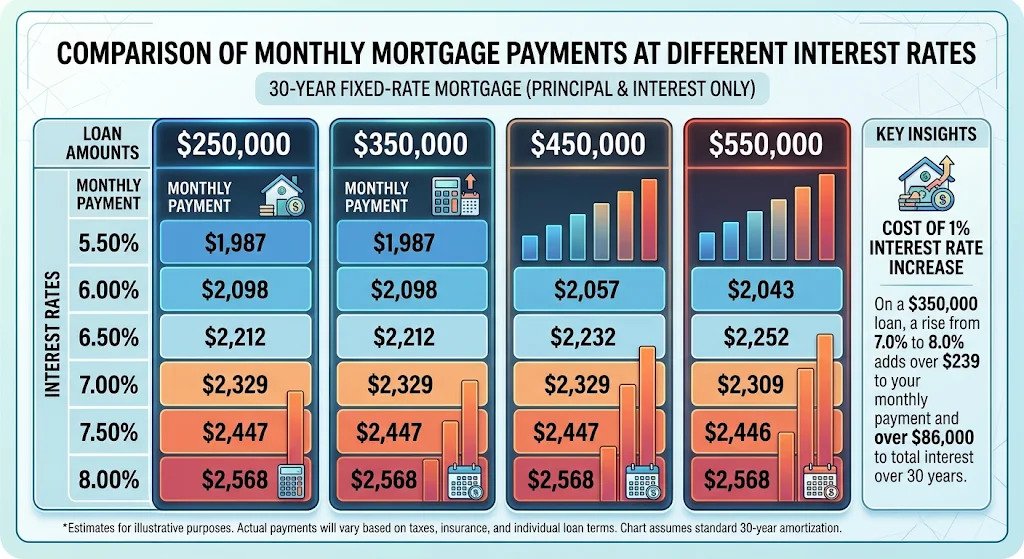
A small rate difference can affect a mortgage payment, particularly on a large loan or over a long repayment period.
Consider a simplified example using a $400,000 30-year fixed mortgage.
At 6.50%, the principal-and-interest payment is approximately $2,528 per month.
At 6.75%, the comparable payment is approximately $2,594 per month.
That is a difference of roughly $66 per month before taxes, insurance, mortgage insurance, and other housing expenses.
The example is not a personalized quote, but it demonstrates why even a quarter-percentage-point difference can matter.
Why the Loan Amount and Term Matter
The effect of a rate change becomes larger as the loan amount increases.
The repayment term also matters. A 30-year loan spreads repayment over a longer period, while a 15-year loan generally requires larger monthly principal-and-interest payments but can reduce total interest over the life of the mortgage.
When Mortgage Points Matter
Discount points are upfront fees paid to the lender in exchange for a lower interest rate, subject to the lender’s pricing.
Whether paying points makes financial sense depends on the upfront cost, monthly savings, and how long the borrower expects to keep the mortgage.
A simple break-even calculation can help:
Break-even period = Cost of points ÷ Monthly payment savings
For example, if points cost $3,000 and reduce the payment by $50 per month, the simple break-even period would be 60 months.
How Can You Get a Better Mortgage Rate?
There is no single strategy that guarantees a lower rate, but borrowers can take steps that may improve their financing options.
Improve Your Credit Profile
Review your credit reports before applying and address inaccurate information when appropriate.
Avoid taking on unnecessary new debt immediately before a mortgage application.
Reduce Your Debt-to-Income Ratio
Paying down qualifying debt can potentially improve your financial profile.
Avoid assuming that income alone determines mortgage eligibility. Monthly debt obligations are also important.
Consider a Larger Down Payment
A larger down payment can reduce the amount borrowed and lower the LTV.
However, putting more money into the property is not automatically the right choice for every household. Buyers should also consider emergency savings, closing costs, moving expenses, and other financial priorities.
Compare Different Loan Programs
A conventional mortgage may not be the only option.
Depending on eligibility, borrowers may compare conventional, FHA, VA, USDA, jumbo, and other mortgage programs.
The right comparison depends on the borrower’s circumstances and the property’s characteristics.
Ask About Mortgage Points
If you plan to keep the mortgage for several years, ask the lender to show pricing both with and without discount points.
The important question is how the upfront cost compares with the expected monthly savings.
Consider a Mortgage Rate Lock
Once you have an acceptable loan offer and are ready to proceed, discuss rate-lock options with your lender.
Understand the lock period and conditions before agreeing to it.
Where Can You Check Mortgage Interest Rates Today?
Consumers can monitor mortgage-rate data from several reputable sources.
Freddie Mac’s Primary Mortgage Market Survey provides weekly national averages. The Federal Reserve Bank of St. Louis also publishes Freddie Mac’s 30-year mortgage series through FRED.
Bankrate provides frequently updated national mortgage-rate information and lender comparisons.
These sources can be useful for understanding market direction, but none should be interpreted as a guaranteed rate for every borrower.
Are Mortgage Rates the Same for Every Borrower?
No. Mortgage pricing can vary from borrower to borrower.
Two people buying similar homes could receive different offers because of differences in:
- Credit history
- Credit score
- Down payment
- Loan amount
- DTI
- Occupancy
- Property type
- Loan program
- Rate-lock timing
- Discount points
- Lender pricing
This is why national averages are best viewed as benchmarks rather than personal quotes.
Should You Wait for Mortgage Rates to Fall?
Trying to predict the exact future direction of mortgage rates is difficult.
Rates can move in response to economic data, inflation, monetary policy expectations, Treasury yields, investor sentiment, and other market forces.
A borrower considering a home purchase can instead focus on measurable factors such as the monthly payment, available cash, loan terms, closing costs, and the household’s long-term budget.
Some borrowers may also consider refinancing in the future if market conditions and their financial circumstances make refinancing beneficial. However, refinancing involves costs and is not guaranteed to produce savings.
Mortgage Interest Rates Today — Frequently Asked Questions
What are mortgage interest rates today?
As of September 24, 2026, Freddie Mac reported a national average of 7.03% for a 30-year fixed mortgage and 6.42% for a 15-year fixed mortgage. Individual lender offers can differ substantially based on borrower and loan characteristics.
What is a good mortgage interest rate in 2026?
There is no single rate that is considered good for every borrower. The appropriate comparison depends on the loan program, credit profile, points, fees, APR, loan term, and prevailing market conditions.
Will mortgage rates go down in 2026?
Future mortgage rates cannot be known with certainty. Economic data, inflation, monetary policy expectations, Treasury yields, and financial-market conditions can all influence rates.
What is the difference between a mortgage rate and APR?
The mortgage interest rate is used to calculate interest on the loan. APR incorporates the interest rate plus certain finance charges, making it useful for comparing the broader cost of different mortgage offers.
How can I get a lower mortgage rate?
Borrowers can compare multiple lenders, maintain a strong credit profile, manage debt, consider different loan programs, evaluate discount points, and ask about rate-lock options. None of these steps guarantees a particular rate.
Should I lock my mortgage rate?
A rate lock can protect an agreed rate for a specified period under the lender’s terms. Before locking, ask about the lock duration, extension rules, costs, and what happens if the closing date changes.
Final Thoughts on Mortgage Interest Rates Today
Mortgage Interest Rates Today are only one part of the home-financing decision. The rate matters, but so do APR, closing costs, points, loan type, monthly payment, and the borrower’s overall financial position.
Current national data show that mortgage pricing remains dynamic in September 2026. Freddie Mac’s latest weekly survey puts the 30-year fixed average at 7.03%, while Bankrate’s September 24 national average is 7.17%, illustrating why different rate surveys can report different figures based on their methodologies and datasets.
For a buyer or homeowner, the most useful next step is to compare personalized loan offers using consistent assumptions. Look beyond the headline rate, understand the fees, and evaluate the payment against your overall budget.