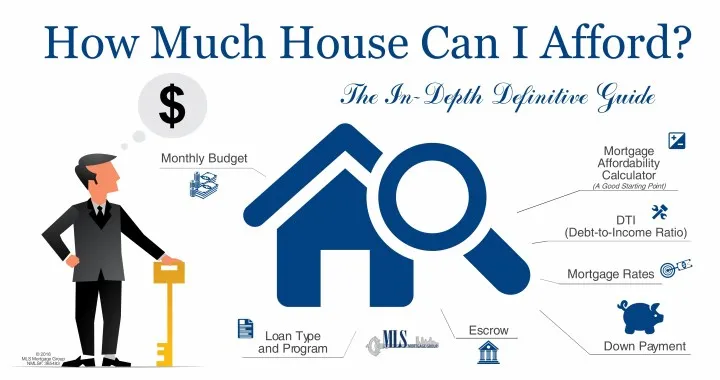
You’ve been scrolling through Zillow. You’ve found the kitchen with the island and the backyard with the tree. But then comes the gut-punch question: “Can I actually pay for this?”
Most online calculators will give you a boring, one-size-fits-all number based on the “28% rule.” But here’s the truth: That number is often wrong.
Your mortgage isn’t just a monthly bill; it’s a lifestyle contract. To find your real number, we need to look at three distinct layers: The Bank’s Number, The Realistic Number, and The Stress-Free Number.
Let’s break down exactly how much house you can afford—without ending up “house poor.”
Part 1: The Bank’s Formula (The Maximum)
First, let’s look at how lenders see you. They want to ensure you won’t default. They use two ratios:
1. The Front-End Ratio (The Housing Cost)
Most lenders cap this at 28% of your gross monthly income (that’s before taxes).
- Example: You earn $8,000/month gross. The bank says: *”We will lend you enough so your principal, interest, taxes, and insurance (PITI) do not exceed $2,240/month.”*
2. The Back-End Ratio (Total Debt)
This includes your future mortgage + car loans + student loans + credit cards. The cap is usually 36% to 43% .
- Example: You have $500 in car/student debt. The bank allows $3,440 total debt (43% of $8k). Minus your $500 existing debt = $2,940 for a mortgage.
The Bank’s Verdict: They will approve you for the higher of those two numbers (usually the back-end ratio). But warning: This is the ceiling of danger, not the floor of comfort.
Part 2: The “Realistic” Formula (The 25% Rule)
If you want to sleep at night, ignore the banks. Follow the 25% (Take-Home) Rule.
Instead of gross income, use your net income (after taxes, health insurance, and 401k contributions).
The Math:
*(Monthly Take-Home Pay) x 0.25 = Your True Mortgage Limit*
Why 25%?
Life happens. Cars break. Roofs leak. Kids get sick. If you spend 35% or 40% of your take-home on a mortgage, you aren’t building wealth; you are just shuffling money from your bank account to the plumber and the grocery store.
- Example: You take home $6,000/month.
- Bank says: You can afford a $2,580 payment.
- Reality says: You should aim for a $1,500 payment.
That extra $1,080/month isn’t “lost.” It’s your freedom fund for vacations, renovations, and retirement.
Part 3: The Hidden Killers (The “Full Worth” Calculation)
Most first-time buyers forget these four costs. They are why people get approved for a $400k house but can only afford a $280k house.
A. Property Taxes
A $350k house in Texas might have $800/month in taxes. The same house in Colorado might have $200/month. Always get the mill rate before you look at the listing.
B. PMI (Private Mortgage Insurance)
If you put down less than 20%, you pay PMI. That is $100–$300/month of pure waste. It does not go to equity.
C. Maintenance (The 1% Rule)
You must save 1% of the home’s value per year for repairs.
- *$300k house = $250/month saved just for the water heater and roof.*
D. Utilities (The Upgrade Gap)
That charming 3,000 sq ft Victorian is $600/month to heat in the winter. Your $1,200 apartment utility bill is about to triple.
Part 4: The 3-Question Stress Test
Before you call a realtor, ask yourself these three questions honestly:
1. Can I handle a 5% interest rate hike?
Rates change. If you buy at the top of your budget and rates go up (or your taxes go up), you are in trouble. Can your budget absorb a $200 payment increase?
2. Will I still save 15% for retirement?
Do not rob your 65-year-old self to pay for your 35-year-old self’s granite countertops. If the mortgage stops your 401k match, the house is too expensive.
3. Do I have 6 months of new expenses saved?
After closing costs and down payment, you need a “Oh crap” fund. If you drain your savings to buy the house, you can’t afford the house.
The Final Calculation (The Spreadsheet Method)
Don’t use a calculator. Use a notepad.
Step 1: Write down your monthly take-home pay. (e.g., $6,500)
Step 2: Subtract your current monthly debt (car, student, credit card). *(e.g., -$800 = $5,700)*
Step 3: Subtract your monthly savings goals (Retirement + Emergency). *(e.g., -$1,000 = $4,700)*
Step 4: Subtract your average monthly spending on food, gas, fun. *(e.g., -$1,500 = $3,200)*
Step 5: This remaining number ($3,200) is your TRUE maximum mortgage payment (PITI).
Now, compare that to what the bank says. I promise you, the bank’s number is at least double this.
The Bottom Line
You can afford the house that allows you to still buy groceries without checking your bank balance first.
You can afford the house that lets you sleep soundly when the Fed raises interest rates.
You can afford the house that leaves you money for the life you actually want to live inside the house.
Don’t shop for the maximum approval. Shop for the monthly payment that feels boring. Boring is wealthy.
Ready to see the real numbers? Take your monthly rent today and add 30%. If that number makes you wince, you aren’t ready to buy yet. If it feels easy, start calling a lender.