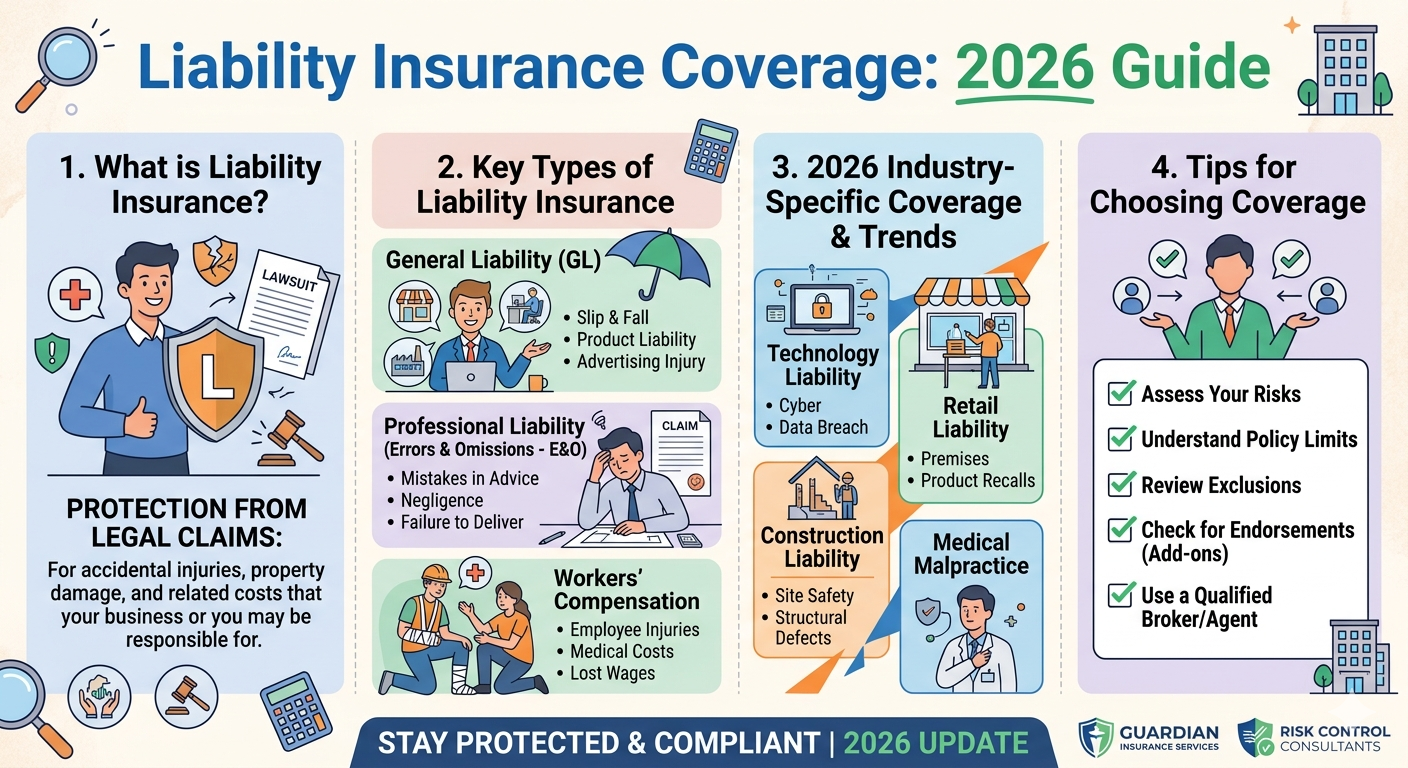
Liability Insurance Coverage: 2026 Guide
What it covers, what it doesn’t, and the one gap that could bankrupt you.
Liability insurance covers the costs you legally owe to other people when you cause an accident or damage their property. It does NOT cover your own injuries, your own car, or your own stuff.
2026 context: Average auto liability claim for bodily injury is $22,000+. A single hospital visit can exceed $50,000. Yet 1 in 8 drivers still carries only state minimum limits (often as low as $15,000).
The reality: If you cause a crash that injures two people, your $25,000 liability limit could be exhausted in the ambulance ride. Anything beyond that comes out of your pocket.
You just backed into your neighbor’s Tesla. Or your dog bit the mail carrier. Or your kid threw a baseball through a church window.
Your heart sinks. Then you remember: I have liability insurance.
But does it actually cover these situations? And more importantly, what’s the fine print that could leave you paying thousands out of pocket?
Let’s break down exactly what liability insurance covers — and the three shocking gaps that most policyholders never see coming.
- Liability insurance pays for injuries and damage you cause to others. Medical bills, lost wages, legal defense, property repairs.
- It never pays for your own injuries or your own property. You need MedPay/PIP and collision/comprehensive for that.
- Auto liability has two parts: Bodily injury (medical bills) and property damage (repairing other people’s cars/fences).
- Homeowners liability covers you anywhere in the world for accidents you cause — even on vacation.
- Umbrella insurance starts at $1 million and kicks in after your auto or home liability limits are exhausted.
What Is Liability Insurance? (The 30-Second Definition)
Liability insurance is a promise. You pay a premium. In exchange, your insurance company agrees to pay for:
- Bodily injury you cause to someone else.
- Property damage you cause to someone else’s stuff.
- Your legal defense if you get sued over an accident.
The key phrase: “you cause.” Liability covers your mistakes. It does not cover acts of nature, theft, or your own losses.
Where you’ll find liability coverage: Auto insurance (required in 49 states), homeowners/renters insurance, umbrella insurance, and business liability.
Auto Liability Insurance: What It Covers (And What It Doesn’t)
Auto liability is split into two categories: Bodily Injury (BI) and Property Damage (PD).
Bodily Injury Liability (BI)
This pays when you injure someone while driving. Covered expenses: hospital bills, lost wages, pain and suffering, funeral costs, and your legal defense.
BI does NOT cover: Your own medical bills (that’s MedPay or PIP), your passengers’ medical bills (unless they sue you), or your lost wages.
Property Damage Liability (PD)
This pays when you damage someone else’s property with your car: other vehicles, fences, buildings, utility poles, bicycles.
PD does NOT cover: Damage to your own car (collision coverage) or theft of your car (comprehensive).
State Minimum Limits: Dangerously Low
| State | Minimum BI per person | Minimum BI per accident | Minimum PD |
|---|---|---|---|
| California | $15,000 | $30,000 | $5,000 |
| Florida | $10,000 (PIP only) | N/A | $10,000 |
| Texas | $30,000 | $60,000 | $25,000 |
| New York | $25,000 | $50,000 | $10,000 |
| Recommended | $100,000 | $300,000 | $100,000 |
Source: Insurance Information Institute, 2026
The trap: A $15,000 BI limit won’t even cover an ambulance ride and a single X-ray. If you cause a multi-car pileup, you’re personally responsible for everything beyond your limit.
Homeowners Liability Insurance: What It Covers
Your homeowners policy includes personal liability coverage for injuries on your property — and damage you cause away from home.
Covered Scenarios Under Homeowners Liability
| Scenario | Covered? | Typical Payout |
|---|---|---|
| Guest slips on your icy driveway | ✅ Yes | $20k–$100k |
| Your dog bites a neighbor | ✅ Yes (most breeds) | $30k–$50k |
| Your child throws a ball through a car windshield | ✅ Yes | $2k–$5k |
| You knock over a vase at a friend’s house | ✅ Yes | $500–$5k |
| Your teenager starts a fire while house-sitting | ✅ Yes | Up to limit |
| You intentionally punch someone | ❌ No | Intentional acts excluded |
Also covers: Legal defense costs, medical payments to others (no-fault, up to $5k), and damage you cause anywhere in the world.
Does NOT cover: Your own injuries (health insurance), damage to your own home (dwelling coverage), car accidents (auto liability), intentional acts, or business activities.
Comparison Table: Liability Limits and Real-World Costs
| Coverage Type | Low (State Min) | Moderate (Recommended) | High (Umbrella-Ready) |
|---|---|---|---|
| Auto BI per person | $15,000 | $100,000 | $250,000 |
| Auto BI per accident | $30,000 | $300,000 | $500,000 |
| Auto PD | $5,000 | $100,000 | $100,000 |
| Homeowners liability | $100,000 | $300,000 | $500,000 |
| Annual auto premium (approx) | $500 | $800 | $1,200 |
| Annual home premium (approx) | $300 | $450 | $600 |
| Out-of-pocket risk if you cause a serious accident | $85k+ | $0 | $0 |
Use our Liability Insurance Needs Calculator to estimate your risk based on your assets, income, and state laws. Enter your net worth and annual earnings — we’ll recommend minimum and ideal coverage limits.
Your liability limit should equal your net worth plus your future earning potential. If you cause an accident exceeding your limits, you can be sued personally.
The formula: Net worth under $100k → $100k/$300k auto. Net worth $100k–$500k → $250k/$500k auto + $500k home liability. Net worth over $500k → add a $1 million umbrella policy (~$150–$300/year).
Common Mistakes to Avoid
1. Assuming “Full Coverage” Includes High Liability
“Full coverage” often still carries state minimum liability limits. Ask your agent for the exact BI/PD numbers.
2. Thinking Homeowners Covers Your Teen’s Car Accident
It does not. Auto accidents are excluded from homeowners policies. Add your teen to your auto policy.
3. Believing Umbrella Insurance Is Only for the Rich
Umbrella policies start at $1 million for ~$150/year. That’s $12.50/month for protection against catastrophic lawsuits.
4. Not Disclosing High-Risk Dogs or Pools
Many insurers exclude dog bites or require extra premiums for pools. Be honest — otherwise claims can be denied.
5. Assuming Liability Covers Intentional Acts
If you deliberately hurt someone, your policy will not pay. Intentional acts are always excluded.
MedPay vs. Liability: What’s the Difference?
| Feature | Liability | MedPay / Medical Payments |
|---|---|---|
| Who it pays | The person you injured | You, passengers, or guests (no fault) |
| Requires fault? | Yes | No |
| Typical limit | $25k–$500k | $1k–$10k |
| Legal defense included? | Yes | No |
| Pain and suffering covered? | Yes (settlements) | No |
Bottom line: MedPay is for quick, small medical bills. Liability is for major claims and lawsuits.
Frequently Asked Questions (People Also Ask)
Q: Does liability insurance cover my own medical bills if I’m at fault?
A: No. Liability pays only for injuries you cause to others. You need health insurance, MedPay, or PIP for your own bills.
Q: Does liability cover rental cars?
A: Usually yes for liability, but damage to the rental car itself requires collision coverage or the rental company’s damage waiver.
Q: Does homeowners liability cover dog bites?
A: Most policies cover dog bites, but some exclude specific breeds (Pit Bulls, Rottweilers). Always check your policy.
Q: What happens if I’m sued for more than my liability limit?
A: Your insurance pays up to your limit. You are personally responsible for the remainder — wage garnishment, bank levies, property liens. This is why umbrella insurance is critical.
Q: Does liability cover my ATV or boat?
A: No. Your auto policy does not cover ATVs, dirt bikes, or boats. You need a separate policy for off-road vehicles or watercraft.
Q: Is liability insurance required by law?
A: For auto, 49 states require liability (New Hampshire is the exception). Homeowners liability is not required by law but mortgage lenders demand it.
Q: How much liability should I carry?
A: Minimum: $100k/$300k auto BI, $100k PD. Homeowners: $300k. If net worth exceeds $500k, add a $1 million umbrella policy.
Q: Does liability cover legal fees if I’m sued?
A: Yes. Your policy includes a duty to defend — the insurer pays for lawyers, court costs, and settlements up to your limit.
Q: Can I be sued personally even with liability insurance?
A: Yes, if the claim exceeds your limits or if your insurer denies coverage (e.g., for an intentional act).
Q: Does liability cover me if I’m driving someone else’s car?
A: Generally, your liability follows you. With permission, your policy is primary. But check your policy for exclusions on non-owned vehicles.
Final Verdict
Liability insurance is the most important coverage you’ll ever buy. It protects your savings, your home, and your future earnings from a single mistake.
But most people buy the state minimum, assume they’re safe, and never think about it again.
The truth: A serious accident can cost $1 million or more. Your $25,000 limit is gone before the ambulance leaves the scene.
Your action plan:
- Check your current liability limits (auto and home).
- If below $100k/$300k auto or $300k home, raise them today.
- If net worth exceeds $500k, buy a $1 million umbrella policy.
- Disclose any high-risk dogs, pools, or trampolines to your insurer.
- Never assume “full coverage” means adequate liability.
The Golden Rule: Buy enough liability insurance so that if you cause a catastrophic accident, you don’t lose everything you’ve worked for. The extra premium is pennies compared to the nightmare of personal bankruptcy.