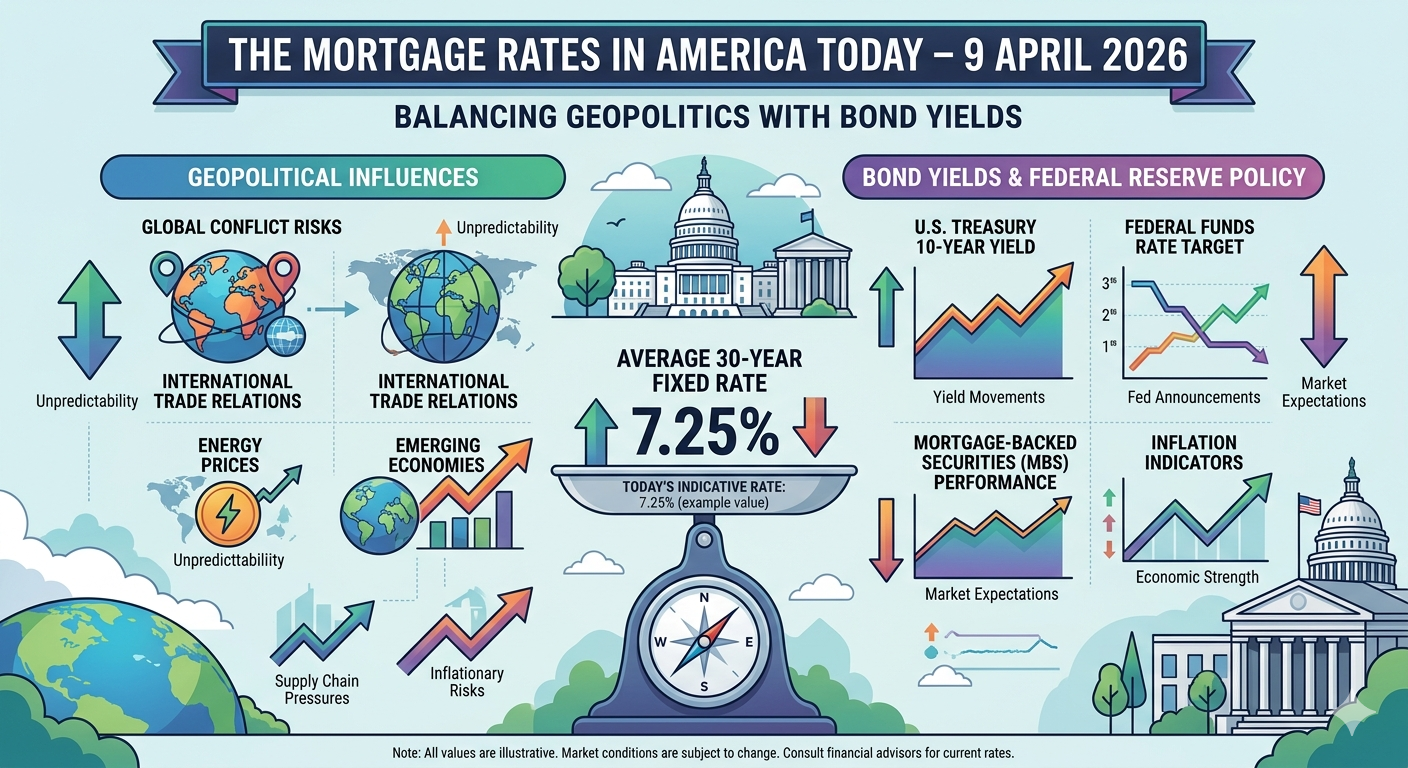
The Mortgage Rates in America Today – 9 April 2026: Balancing Geopolitics with Bond Yields
In the United States, mortgage rates are beginning to ease in the second week of the month. This is a welcome relief for buyers after a turbulent spring. Key rates are now slightly lower after a steep rise in March, driven by rising oil and geopolitical tensions. The market is now focusing on the Federal Reserve and the movements of the bond markets.
Current Mortgage Rates (as of early April 2026)
Mortgage rates are expected to remain stable in the range of low-to-mid-6% until April 9, 2026. The latest data available from major surveys in the industry:
| Loan Type | Interest Rate | APR (Approx.) |
|---|---|---|
| 30-Year Fixed-Rate (Conforming) | 6.51% | 6.48% – 6.73% |
| 15-Year Fixed-Rate Mortgage | 5.77% – 5.90% | 5.93% – 7.25% |
| 30-Year Fixed-Rate Jumbo | 6.54% – 6.60% | — |
| 5/1 Adjustable-Rate Mortgage (ARM) | 5.72% | 6.15% |
| 30-Year Fixed-Rate FHA | 6.22% | 6.34% |
| 30-Year Fixed-Rate VA | ~5.63% – 6.38% | ~6.02% – 6.42% |
The Key Facts Behind the Numbers
According to Mortgage Bankers Association, the national average of a conforming 30-year loan with a fixed rate has decreased to 6.51% for the week ended April 3. The average 30-year fixed-rate conforming loan has decreased slightly to 6.51% as of the week ending April 3, according to Mortgage Bankers Association (MBA). This is a slight improvement over 6.57% from the prior week. The Freddie Mac Primary Mortgage Market Survey, which uses a different schedule to measure rates, showed that the average 30-year fixed rate was 6.46% in the week ended April 2. This is a slight increase from 6.38% last week.
The MBA reports an average rate of 5.90% for 15-year mortgages. Freddie Mac reported a 5.77% average.
For borrowers who are comfortable with the possibility of future rate adjustments, adjustable-rate mortgages continue to be offered at lower rates. Nationally, the average 5/1 ARM has an APR around 6.15%. The increase of ARMs has resulted in an 8.6% rise of the total number of applications by early April.
Conditions for government-backed loans have also improved. FHA loan rates are around 6.22% and VA loans can be as low as 5.625 percent from major lenders. These lower interest rates have supported purchase applications. FHA applications for purchase are up by 5% in the last week.
What are the main drivers of rate changes?
Recent stabilization in mortgage rates is due to several factors that have been balancing out.
1. The Oil Price and Geopolitical Tensions
In March, the Middle East conflict escalated and was a major factor in driving the spike. Oil prices rose to $100 per barrel after the war in Iran, and subsequent blocking of the Strait of Hormuz. This is a crucial chokepoint for oil shipping worldwide. Geopolitical instabilities fuel inflation concerns, driving mortgage rates and long-term bond returns higher. While the current situation is still tense as of April 9, a recent two-week truce has brought some relief to the market, and allowed yields to drop slightly.
2. Ten-Year Treasury Yield
The Federal Reserve does not set mortgage rates directly, but they are tied closely to the yield of the U.S. Treasury 10-year note. The yield is the main benchmark used to determine long-term borrowing rates. Early April 2026 saw the yield on the 10-year note hovering between 4.31% and 4.36%. This was up from a low of 4% at late February. Recent ceasefire announcements have helped lower yields, which has in turn eased upward pressure on mortgage interest rates.
3. Federal Reserve Policy
Federal Reserve’s benchmark rate has remained unchanged so far this year, 2026. The federal funds range is still at 3.50-3.75% following a number of reductions in late 2025. The Fed’s 10-year Treasury is more important to mortgage rates than the Fed short-term rate. Market expectations have been stabilized by the Fed’s current “wait and see” attitude, as well as Jerome Powell’s statement that further reductions are now more difficult. According to the consensus, there is a possibility that the Fed will make one additional cut in 2026. Mortgage rates are expected to remain around 6% throughout the entire year.
MBA Weekly Survey: Markets in Transition
Mortgage Bankers Association’s (MBA) Weekly Mortgage Applications Survey, for the week ended April 3, 2026 was released by the MBA on 8 April. It provides valuable insights into the reactions of borrowers to current rates.
- Overall volume of mortgage applications has decreased 0.8% compared to the week before, which indicates that borrowers are still cautious.
- Purchase Applications – The weekly adjusted Purchase Index rose by 1%, indicating a certain resilience of the homebuying market. Purchase applications are still down 7% from the same time last year, the first decline in the annual average since January 2025.
- Refinance activity: Refinance Index fell by 3% compared to the week before and 4% compared to the same period a year earlier. The rate of refinancing applications has been at its lowest since December 2025. This is because many refinancing applicants have been put off by the recent rapid rise in interest rates.
- FHA Loans saw an increase of 5% in applications for purchase, largely due to their lower interest rates (roughly 30 basis point below conventional loans). An increase of 8.6% in ARM applications was also seen, with some borrowers seeking lower rates at the beginning.
Expert Outlook: What Next for Mortgage Interest Rates?
Experts are divided about the future direction of mortgage rates.
Short-Term Outlook (Next 2 to 3 Weeks)
Rates are expected to stay relatively flat in the near future. It is anticipated that the announcement of a ceasefire in the Middle East will put downward pressure on interest rates. This could allow the 30-year fixed-rate to stabilise or even modestly decrease. This trend could be reversed quickly if geopolitical tensions resurface or if there are signs of inflation.
Medium-Term Outlook (2026)
The majority of housing economists are in agreement that rates will not fall much over the next few months. Mortgage Bankers Association predicts rates to remain at or above 6% until 2026 with an almost flat trend. Fannie Mae, on the other hand, is optimistic and predicts that rates will fall to 5.7% at the end of this year. This forecast, however, was made prior to the recent rise in interest rates.
Borrowers: Practical Advice
Here are some key points to consider for those who want to buy a home or refinance:
For Home Buyers
- Do not wait for lower rates: According to experts, waiting for rates that are significantly less than 6% could prove risky as they will likely remain higher for the near future.
- Shop around: Comparing quotes with different lenders could save you up to thousands over the course of your loan.
- Consider ARMs: If you are planning to refinance or move within the next 5 to 7 years, ARMs could provide a better initial rate than fixed-rate mortgages.
- Look into Government Loans: FHA and VA loan rates are often lower than those of conventional mortgages. If you meet the requirements, it may be worthwhile to explore these options.
For Refinancers
- Evaluate your position: With the number of refinance requests at its lowest since December 2025, it is essential to determine whether current rates are enough to save to justify closing costs.
- Keep an eye out for rate dips: While you may need to wait until rates are significantly lower before applying, monitoring daily changes in the market could be a good way to time your application.
Last Thoughts
On April 9, 2026 mortgage rates will reflect the market’s struggle between two competing forces. Geopolitical uncertainties are pushing up rates, while bond market dynamics are pulling them down. Homebuyers can take advantage of the current market, but it requires planning, and some realistic expectations. Mortgage rates are higher now than they were in recent years, though still below those seen at the peak of 2024 and 2025. The best mortgage rates are those that you can get today and fit your financial long-term goals.